题解:P3375 【模板】KMP
niu_zh
·
·
题解
此题解下标统一从 1 开始。
前置芝士
举个栗子,对于字符串 abcabcd:
$a[2]=0$,因为 `ab` 无相等的真前缀和真后缀。
$a[3]=0$,因为 `abc` 无相等的真前缀和真后缀。
$a[4]=1$,因为 `abca` 相等的真前缀和真后缀最长为 `a`,长度为 $1$。
$a[5]=2$,因为 `abcab` 相等的真前缀和真后缀最长为 `ab`,长度为 $2$。
$a[6]=3$,因为 `abcabc` 相等的真前缀和真后缀最长为 `abc`,长度为 $3$。
$a[7]=0$,因为 `abcabcd` 无相等的真前缀和真后缀。
同理,字符串 `aabaaab` 的前缀函数为 `[0,1,0,1,2,2,3]`。
根据定义,我们可以写一个朴素做法,直接暴力求:
```cpp
#include<bits/stdc++.h>
using namespace std;
const int N=1e6+10;
int a[N];
int main()
{
string s;
cin>>s;
int n=s.size();
s=" "+s;
for (int i=1; i<=n; i++)
{
for (int j=i-1;j>=0;j--)
{
if (s.substr(1,j)==s.substr(i-j+1,j))
{
a[i]=j;
break;
}
}
}
for (int i=1; i<=n; i++)
{
cout<<a[i]<<" ";
}
return 0;
}
```
可是显然,此代码时间复杂度为 $O(n^3)$,特别慢。
考虑进行优化:
对栗子中的前缀函数进行观察,可以发现,**相邻的前缀函数最多增加 $1$**。并且只在 $s_{i+1}=s_{a_i}$ 时 $a_{i+1}=a_i+1$。
优化后的代码:
```cpp
#include<bits/stdc++.h>
using namespace std;
const int N=1e6+10;
int a[N];
int main()
{
string s;
cin>>s;
int n=s.size();
s=" "+s;
for (int i=1; i<=n; i++)
{
for(int j=min(a[i-1]+1,i-1); j>=0; j--)
{
if (s.substr(1,j)==s.substr(i-j+1,j))
{
a[i]=j;
break;
}
}
}
for (int i=1; i<=n; i++)
{
cout<<a[i]<<" ";
}
return 0;
}
```
时间复杂度为 $O(n^2)$。
在上一个优化中,我们知道了在且只在 $s_{i+1}=s_{a_i}$ 时前缀函数才会增加 $1$,接下来,我们考虑其他情况时的取值。
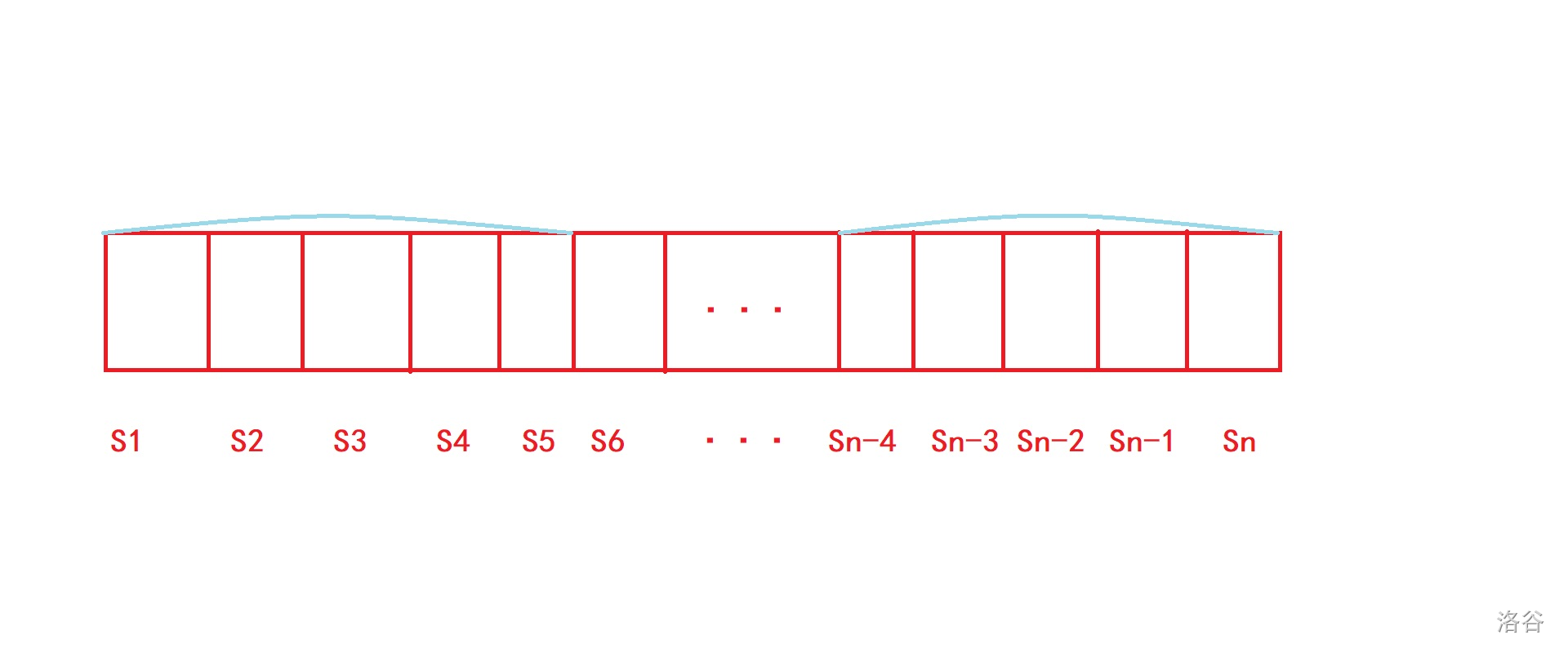
举个栗子,上图中 $a_n=5$,我们加入第 $n+1$ 位:
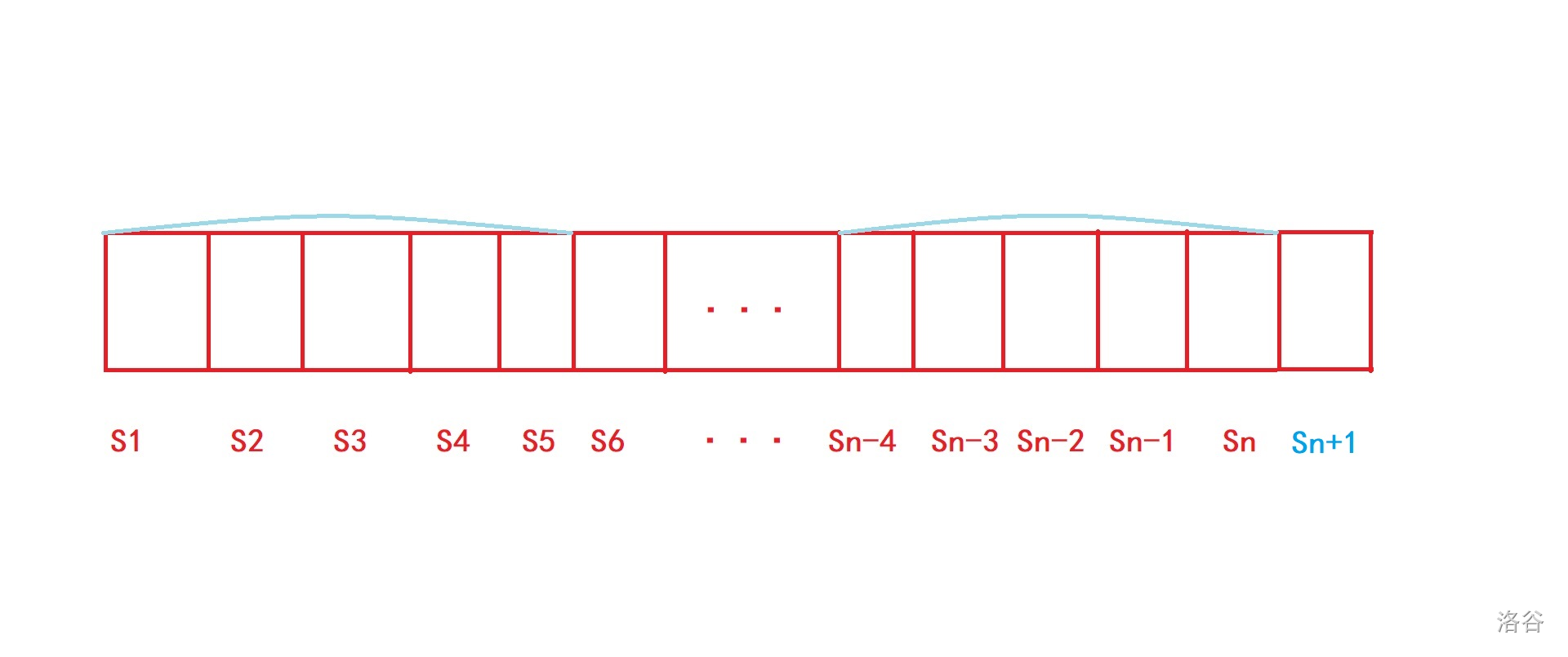
首先,我们先让 $s_{n+1}$ 与 $s_{a_n}$ 进行比较,发现不相等。
接下来,我们肯定要考虑仅次于 $a_n$ 的第二长度 $tmp$,使其满足前缀性质,也就是 $s[1...tmp]=s[n-tmp+1...n]$。
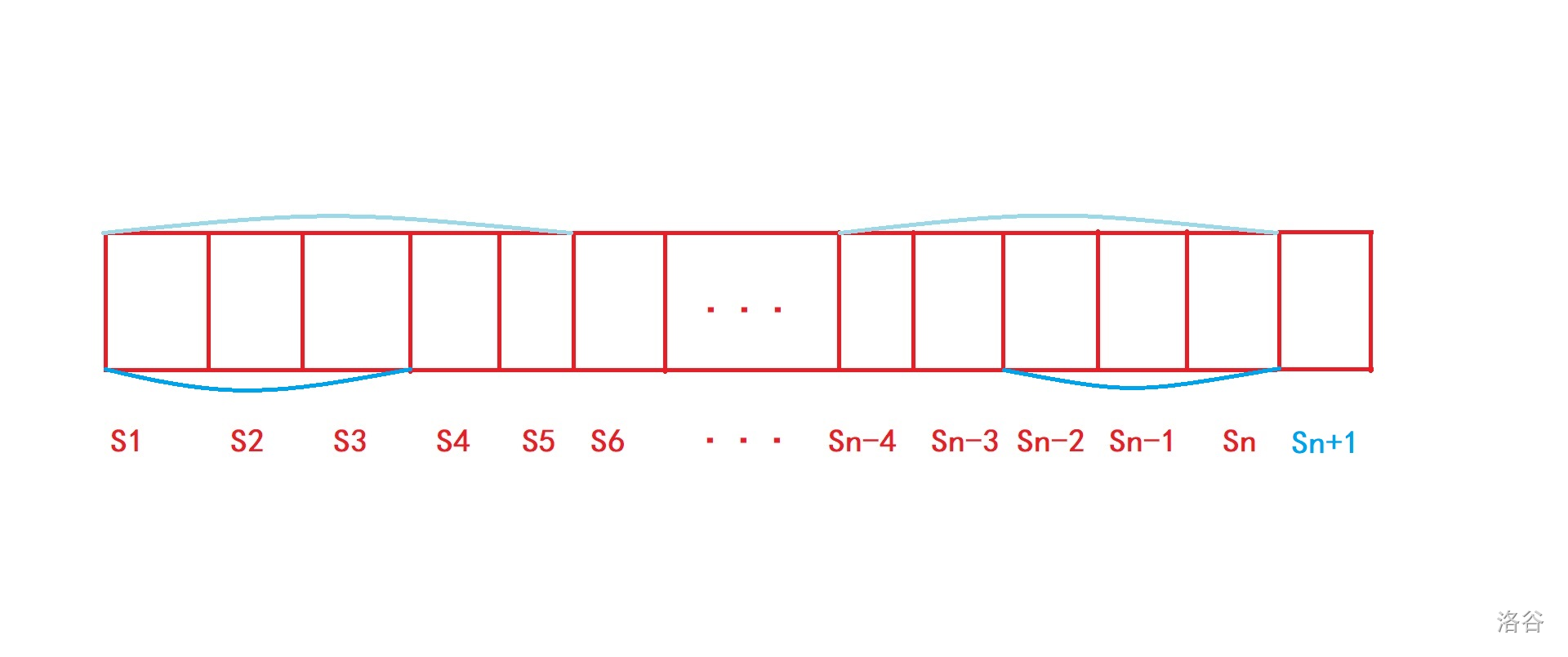
如果找到了这样的 $tmp$,就比较 $s_{tmp+1}$ 与 $s_{a_n}$。如果相等,那么$a_{n+1}=tmp$,否则再重复上面的操作。
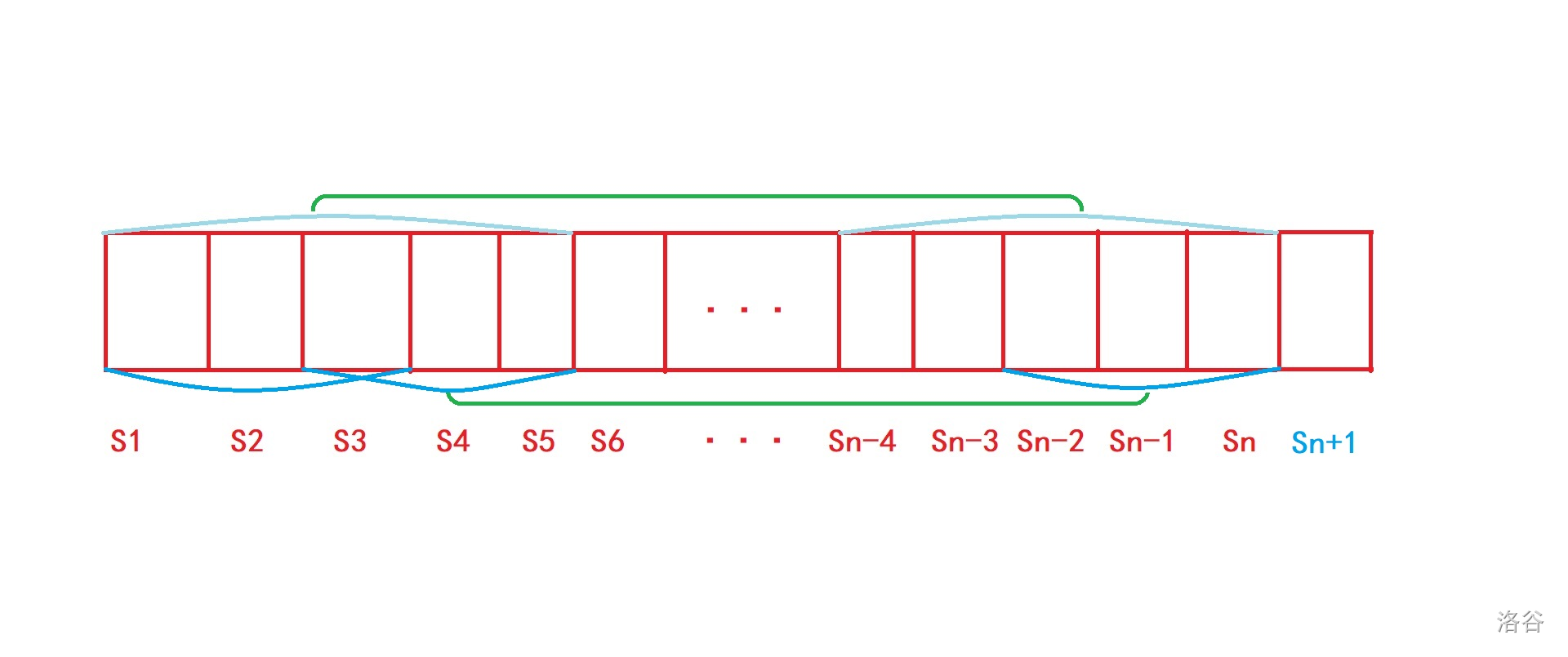
我们可以发现,其实 $tmp$ 就是 $a_{a_n}$。因为 $s[a[n]-tmp+1...a[n]]=s[n-tmp+1...n]$,所以只在 $tmp=a_{a_n}$ 时,才有最大的 $tmp$ 使 $s[1...tmp]=s[a[n]-tmp+1...a[n]]=a[n-tmp+1...n]$。
因此,我们可以对代码再次进行优化:
```cpp
#include<bits/stdc++.h>
using namespace std;
const int N=1e6+10;
int a[N];
int main()
{
string s;
cin>>s;
int n=s.size();
s=" "+s;
for (int i=2; i<=n; i++)
{
int tmp=a[i-1]+1;
while(tmp>1&&s[i]!=s[tmp])
{
tmp=a[tmp-1]+1;
}
if(s[i]!=s[tmp])
{
tmp--;
}
a[i]=tmp;
}
for (int i=1; i<=n; i++)
{
cout<<a[i]<<" ";
}
return 0;
}
```
此时代码时间复杂度已经来到了 $O(n)$。
~~好的所以这跟 kmp 有什么关系呢?~~
设我们想在长度为 $m$ 的字符串 $s_1$ 中找到长度为 $n$ 的字符串 $s_2$ 的所以出现位置。
我们考虑构造一个字符串 $s_2+$`#`$+s_1$,其中 `#` 是一个不出现在 $s_1$ 也不出现在 $s_2$ 的字符。现在对此字符串跑一边前缀函数。可以发现,如果有 $k$ 使 $a_k=n$,$s_2$ 就在 $s_1$ 的 $k-(n+1)-n+1$ 处出现了一次。这样我们就在 $O(n+m)$ 的时间内解决该问题了。

### 代码
```cpp
#include<bits/stdc++.h>
using namespace std;
const int N=1e6+10;
int a[N<<1];
vector<int> ans;
int main()
{
string s1,s2;
cin>>s1>>s2;
int n=s2.size();
string k=s2+'#'+s1;
int t=k.size();
s1=" "+s1;
s2=" "+s2;
k=" "+k;
for (int i=2; i<=t; i++)
{
int tmp=a[i-1]+1;
while(tmp>1&&k[i]!=k[tmp])
{
tmp=a[tmp-1]+1;
}
if(k[i]!=k[tmp])
{
tmp--;
}
a[i]=tmp;
if(a[i]==n)
{
ans.push_back(i-2*n);
}
}
for(auto x:ans)
{
cout<<x<<'\n';
}
for(int i=1; i<=n; i++)
{
cout<<a[i]<<' ';
}
return 0;
}
```
其实因为 kmp 是在线算法,我们可以省去 $k$ 的空间。
```cpp
#include<bits/stdc++.h>
using namespace std;
const int N=1e6+10;
string s2,s1;
int a[N];
int main()
{
int n,m;
cin>>s1>>s2;
n=s2.size();
m=s1.size();
s2=' '+s2;
s1=' '+s1;
for(int i=2,tmp;i<=n;i++)
{
tmp=a[i-1]+1;
while(tmp>1&&s2[i]!=s2[tmp])
{
tmp=a[tmp-1]+1;
}
if(s2[i]!=s2[tmp])
{
tmp--;
}
a[i]=tmp;
}
for(int i=1,tmp=1;i<=m;i++)
{
while(tmp>1&&s1[i]!=s2[tmp])
{
tmp=a[tmp-1]+1;
}
if(s1[i]!=s2[tmp])
{
tmp--;
}
if(tmp==n)
{
cout<<i-n+1<<"\n";
tmp=a[tmp];
}
tmp++;
}
for(int i=1;i<=n;i++)
{
cout<<a[i]<<" ";
}
return 0;
}
```