题解:P5490 【模板】扫描线 & 矩形面积并
TH911
·
·
题解
例题链接 不知道是否更好的阅读体验
Upd 2026/10/26:发现代码粘错了。
给定平面直角坐标系内 n 个四边平行于坐标轴的矩形,求其面积并。第 i 个矩形的左下角和右上角分别为 (x_{1,i},y_{1,i}),(x_{2,i},y_{2,i})。
扫描线思想
扫描线,顾名思义,就是模拟一条线在平面上扫来扫去,从而得出答案。
这一般用于图特别大以致于无法存储的情况。
如图(来自 OI Wiki),图中描绘的就是扫描线从下至上扫过的情况。当坐标系非常大以致于无法存储时,就可以运用扫描线,模拟一条线扫过值域,扫的同时统计答案即可。
扫描线算法
接下来讲解如何具体实现扫描线算法,以维护矩形面积并为例。其余信息都是类似的。
指针扫过一维
很简单,使用一个指针每次自增即可。不妨令其从左至右扫过。
我们需要知道的就是当前这一列内被覆盖的长度 \textit{len}_i,答案即所有 \textit{len}_i 之和。
数据结构维护一维
维护纵轴上的区间信息,一般使用线段树。
具体而言,我们需要使用线段树维护纵区间内的值,有两种操作:
- 区间加 1 或区间减 1,且加/减区间两两对应。(见下文)
- 求根节点维护区间内非 0 的数的个数。(如上文)
一般的线段树可能无法很好的维护此类信息,因为你并不知道减 1 之后有多少数会变成 0。
但是扫描线用到的线段树具有一个很强的性质:加/减区间两两对应。
那么也就是说,加操作与其对应的减操作在线段树上操作的的节点互相对应。
因此可以考虑对于每一个节点 i,记 \textit{cover}_i 表示 i 对应区间被整体覆盖的次数,\textit{len}_i 为 i 对应区间内被覆盖的长度。
* 若 $\textit{cover}_i>0$,则必有 $\textit{len}_i$ 为对应区间长度。
* 否则,记 $\textit{lChild}_i,\textit{rChild}_i$ 分别为 $i$ 的左右子节点,有 $\textit{len}_i=\textit{len}_{\textit{lChild}_i}+\textit{len}_{\textit{rChild}_i}$。
这也是标记上传的逻辑。
***
为了便于表述,记矩形的左下角和右上角分别为 $(x_1,y_1),(x_2,y_2)$。
根据上文的图,因为此处是从左至右扫过,因此可以:
* 扫到矩形的**左边界** $x_1$ 时将 $[y_1+1,y_2]$ 全部加上 $1$,代表这一段都被矩形覆盖了。
* 扫到矩形的**右边界** $x_2$ 时将 $[y_1+1,y_2]$ 全部减去 $1$,代表这一个矩形结束了,之后都不会被这个矩形覆盖(但是仍然可能被其他矩形覆盖)。
**注意矩形对应区间不是 $[y_1,y_2]$**,而是 $[y_1+1,y_2]$。
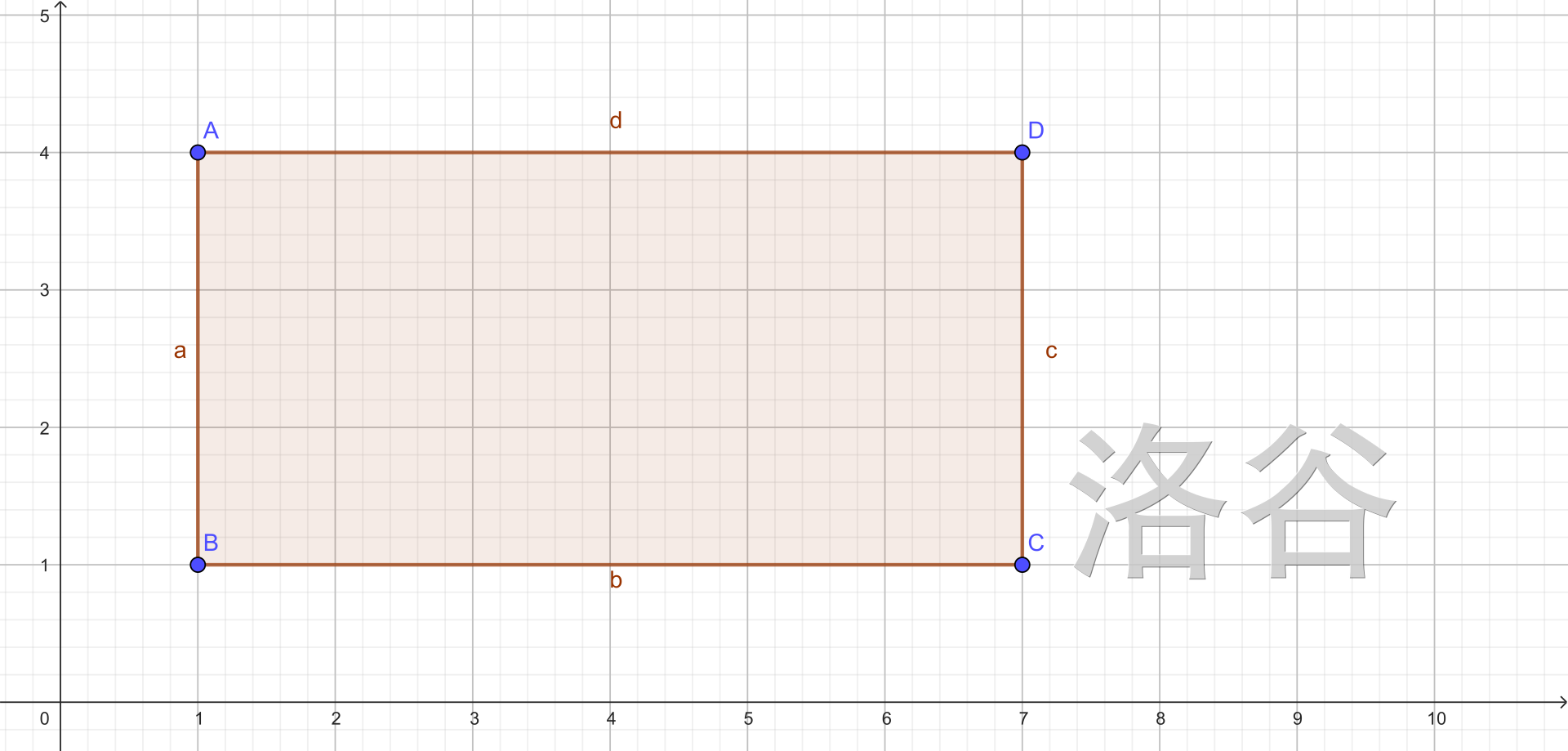
~~这个水印为什么这么大?~~
如图,$A(1,4),B(1,1)$,但是 $AB=4-1=3$,对应第 $2\sim 4$ 行。**线段树维护的是第几行**。(当然,你也可以说是 $1\sim 3$ 行,对应上文 $[y_1+1,y_2]$ 改为 $[y_1,y_2-1]$,但是没有本质区别,相当于整体偏移。)
这里提供一份参考代码。
:::success[参考代码]
但是这份代码无法通过例题的任意测试点,因为所有测试点的 $x,y$ 都是跑满 $10^9$ 的。数组会越界。
```cpp
//#include<bits/stdc++.h>
#include<algorithm>
#include<iostream>
#include<cstring>
#include<iomanip>
#include<cstdio>
#include<string>
#include<vector>
#include<cmath>
#include<ctime>
#include<deque>
#include<queue>
#include<stack>
#include<list>
using namespace std;
typedef long long ll;
constexpr const int N=1e5,V=1e5;
struct line{
int l,r,w;
};
vector<line>q[N<<1|1];
struct segTree{
struct node{
int l,r;
int len,cover;
}t[N<<3|1];
int size(int p){
return t[p].r-t[p].l+1;
}
void up(int p){
if(t[p].cover){
t[p].len=size(p);
}else{
if(t[p].l==t[p].r){
t[p].len=0;
}else{
t[p].len=t[p<<1].len+t[p<<1|1].len;
}
}
}
void build(int p,int l,int r){
t[p]={l,r};
if(l==r){
t[p].cover=0;
t[p].len=0;
return;
}
int mid=l+r>>1;
build(p<<1,l,mid);
build(p<<1|1,mid+1,r);
up(p);
}
void add(int p,int l,int r,int k){
if(l<=t[p].l&&t[p].r<=r){
t[p].cover+=k;
up(p);
return;
}
if(l<=t[p<<1].r){
add(p<<1,l,r,k);
}
if(t[p<<1|1].l<=r){
add(p<<1|1,l,r,k);
}
up(p);
}
int query(){
return t[1].len;
}
}t;
int main(){
/*freopen("test.in","r",stdin);
freopen("test.out","w",stdout);*/
ios::sync_with_stdio(false);
cin.tie(0);cout.tie(0);
int n;
cin>>n;
static int x1[N+1],y1[N+1],x2[N+1],y2[N+1];
for(int i=1;i<=n;i++){
cin>>x1[i]>>y1[i]>>x2[i]>>y2[i];
}
for(int i=1;i<=n;i++){
q[x1[i]].push_back({y1[i],y2[i],1});
q[x2[i]].push_back({y1[i],y2[i],-1});
}
t.build(1,0,V);
ll ans=0;
for(int i=0;i<=V;i++){
for(auto x:q[i]){
t.add(1,x.l+1,x.r,x.w);
}
ans+=1ll*t.query();
}
cout<<ans<<'\n';
cout.flush();
/*fclose(stdin);
fclose(stdout);*/
return 0;
}
```
:::
## 离散化
一般来讲,扫描线算法是需要离散化的。因为平面往往很大,超过 $10^6\times10^6$ 时往往需要离散化。
当然,线段树维护的纵区间可以不离散化,**动态开点权值线段树**维护即可;但是这样第一常数更大,第二横区间本来就要离散化,纵区间也可以顺带离散化。
记 $\operatorname{hashX}(x)$ 为排名为 $x$ 的原来的有效 $x$,$\operatorname{hashY}(y)$ 同理。
此时线段树维护的区间 $[l,r]$ 便是排名在 $[l,r]$ 内的有效 $y$。其区间长度为 $\operatorname{hashY}(r)-\operatorname{hashY}(l-1)$。**注意不是 $\operatorname{hashY}(r)-\operatorname{hashY}(l)$**。
同时,指针扫到 $i$ 时,这一整段相同的列的数量为 $\operatorname{hashX}(i+1)-\operatorname{hash}(i)$。
# 例题 AC 代码
```cpp
//#include<bits/stdc++.h>
#include<algorithm>
#include<iostream>
#include<cstring>
#include<iomanip>
#include<cstdio>
#include<string>
#include<vector>
#include<cmath>
#include<ctime>
#include<deque>
#include<queue>
#include<stack>
#include<list>
using namespace std;
typedef long long ll;
constexpr const int N=1e6,V=1e5;
struct line{
int l,r,w;
};
vector<line>q[N<<1|1];
int hashX[N<<1|1],hashY[N<<1|1];
struct segTree{
struct node{
int l,r;
int len,cover;
}t[N<<3|1];
int size(int p){
return hashY[t[p].r+1]-hashY[t[p].l];
}
void up(int p){
if(t[p].cover){
t[p].len=size(p);
}else{
t[p].len=t[p<<1].len+t[p<<1|1].len;
}
}
void build(int p,int l,int r){
t[p]={l,r};
if(l==r){
t[p].cover=0;
t[p].len=0;
return;
}
int mid=l+r>>1;
build(p<<1,l,mid);
build(p<<1|1,mid+1,r);
up(p);
}
void add(int p,int l,int r,int k){
if(l<=t[p].l&&t[p].r<=r){
t[p].cover+=k;
up(p);
return;
}
if(l<=t[p<<1].r){
add(p<<1,l,r,k);
}
if(t[p<<1|1].l<=r){
add(p<<1|1,l,r,k);
}
up(p);
}
int query(){
return t[1].len;
}
}t;
int main(){
/*freopen("test.in","r",stdin);
freopen("test.out","w",stdout);*/
ios::sync_with_stdio(false);
cin.tie(0);cout.tie(0);
int n;
cin>>n;
static int x1[N+1],y1[N+1],x2[N+1],y2[N+1];
for(int i=1;i<=n;i++){
cin>>x1[i]>>y1[i]>>x2[i]>>y2[i];
hashX[i]=x1[i];hashX[i+n]=x2[i];
hashY[i]=y1[i];hashY[i+n]=y2[i];
}
int lenX=n<<1,lenY=n<<1;
sort(hashX+1,hashX+lenX+1);
sort(hashY+1,hashY+lenY+1);
lenX=unique(hashX+1,hashX+lenX+1)-hashX-1;
lenY=unique(hashY+1,hashY+lenY+1)-hashY-1;
for(int i=1;i<=n;i++){
x1[i]=lower_bound(hashX+1,hashX+lenX+1,x1[i])-hashX;
x2[i]=lower_bound(hashX+1,hashX+lenX+1,x2[i])-hashX;
y1[i]=lower_bound(hashY+1,hashY+lenY+1,y1[i])-hashY;
y2[i]=lower_bound(hashY+1,hashY+lenY+1,y2[i])-hashY;
q[x1[i]].push_back({y1[i],y2[i],1});
q[x2[i]].push_back({y1[i],y2[i],-1});
}
t.build(1,1,lenY);
ll ans=0;
for(int i=1;i<=lenX;i++){
for(auto x:q[i]){
t.add(1,x.l,x.r-1,x.w);
}
ans+=1ll*(hashX[i+1]-hashX[i])*t.query();
}
cout<<ans<<'\n';
cout.flush();
/*fclose(stdin);
fclose(stdout);*/
return 0;
}
```