AC自动机
紫钦
·
·
个人记录
在学习 AC 自动机之前,一定要先学会 KMP 算法和 Trie 树(以后有时间再填这个坑吧)。
***
$AC$ 自动机是高效解决多模式匹配的**数据结构**。
利用 $Trie$ 树构建失配指针,达到 $O(n)$ 多模式匹配的目的。
像 $KMP$ 的 $next$ 数组一样,$AC$ 自动机使用 $fail$ 数组来优化失配时的转移过程,$fail$ 即为失配指针。
***
首先用 $Trie$ 树存储所有的模式串。像这样:
```cpp
INPUT:
5
ache
headache
hehe
heache
ac
```
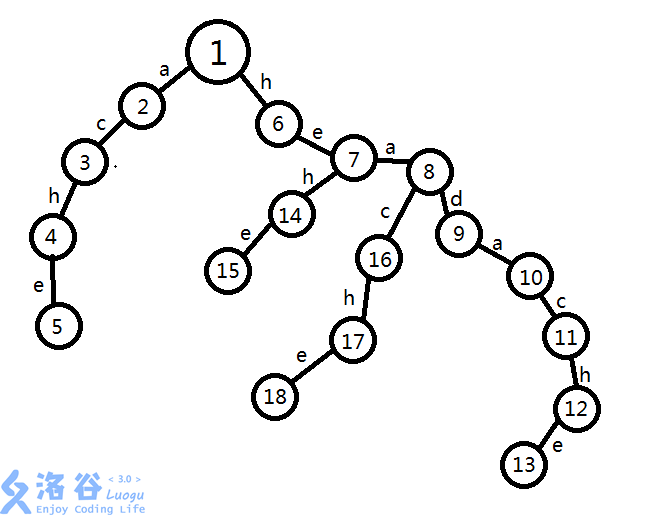
$tr[i].fail$ 保存一个是当前串(从根到 $i$ 的串)的最大后缀的位置,比如 $headache$ 在 $Trie$ 中的最大后缀为 $ache$ ,那么 $tr[13].fail=5$。
具体的,每次失配时,沿着 $fail$ 转移,找到能够匹配的位置继续匹配。
***
```cpp
#include<cstdio>
#include<cmath>
#include<iostream>
#include<cstring>
#include<queue>
using namespace std;
const int CHARSET_SIZE=26;
const char BASH_CHAR='a';
const int N=100005;
struct Aho_Corasick_Automation {
int CNT=1;
struct Trie_Node {
int c[CHARSET_SIZE],next,fail; // 表示孩子们、后缀连接、失配指针。
bool isword; // 表示是不是模式串。
int ans; // 表示模式串在文本串中出现的次数。
Trie_Node(bool I=false): ans(0), isword(I), next(0), fail(0) {for(int i=0;i<CHARSET_SIZE;++i) c[i]=0;}
} tr[N];
void apply(int cur)
{
while(tr[cur].next) ++tr[cur].ans, cur=tr[cur].next;
++tr[cur].ans;
}
Aho_Corasick_Automation() {}
int Newnode()
{
return ++CNT;
}
int insert(char str[]) // 返回新插入单词的位置。
{
int cur=1;
int now=0, now_c=0, len=strlen(str);
while(now<len) {
now_c=str[now]-'a';
if(!tr[cur].c[now_c]) tr[cur].c[now_c]=Newnode();
cur=tr[cur].c[now_c];
++now;
}
tr[cur].isword=true;
return cur;
}
void build()
{
std::queue <int> q;
tr[1].fail=1;
tr[1].next=0;
for(int i=0;i<CHARSET_SIZE;++i) {
if(tr[1].c[i]) {
q.push(tr[1].c[i]);
tr[tr[1].c[i]].fail=1;
tr[tr[1].c[i]].next=0;
}
}
register int cur=0,now=0,j;
while(!q.empty()) {
cur=q.front();
q.pop();
for(int i=0;i<CHARSET_SIZE;++i) {
if(now=tr[cur].c[i]) {
j=tr[cur].fail;
while(j!=1 && !tr[j].c[i]) j=tr[j].fail;
tr[now].fail=(tr[j].c[i]? tr[j].c[i]:1);
q.push(now);
}
}
tr[cur].next=(tr[tr[cur].fail].isword? tr[cur].fail:tr[tr[cur].fail].next); // 此处并不能加条件判断,否则需要递归。不加条件判断则只需要选择。
}
}
void exec(const char str[])
{
int len=strlen(str), cur=1, now_c=0;
for(int i=0;i<len;++i) {
now_c=str[i]-'a';
while(cur!=1 && (!tr[cur].c[now_c])) cur=tr[cur].fail;
cur=(tr[cur].c[now_c]? tr[cur].c[now_c]:1);
if(tr[cur].isword) apply(cur); // 每个串的后缀连接都有可能不为空。
else if(tr[tr[cur].next].isword) apply(tr[cur].next); // 注意是 else if,防止过多的计算。
}
}
void clear()
{
for(int i=1;i<=CNT;++i) {
tr[i]=Trie_Node();
}
CNT=1;
}
void Debug() // 这个也留着吧。。。
{
char C[]={'a','b','c','d','e','f','g','h','i','j','k','l','m','n','o','p','q','r','s','t','u','v','w','x','y','z'};
for(int i=1;i<=CNT;++i) {
printf("tr[%d]:\nson:",i);
for(int j=0;j<13;++j) {
printf("%c:%d ",C[j],tr[i].c[j]);
}putchar('\n');printf(" ");
for(int j=13;j<26;++j) {
printf("%c:%d ",C[j],tr[i].c[j]);
}putchar('\n');
printf("next=%d fail=%d isword=%d ans=%d\n",tr[i].next,tr[i].fail,tr[i].isword,tr[i].ans);
}
}
}AC_Au;
char buf[10000001], *buf_S, *buf_T;
char get_char()
{
if(buf_S==buf_T) {
buf_T=(buf_S=buf)+fread(buf,1,10000000,stdin)-1;
if(buf_S==buf_T) return EOF;
return *buf_S;
}
return *++buf_S;
}
#define getchar get_char
int read()
{
char ch=getchar(); int x=0;
while(ch<'0' || ch>'9') ch=getchar();
while(ch>='0'&&ch<='9') x=(x<<3)+(x<<1)+(ch^48), ch=getchar();
return x;
}
void reads(char str[])
{
char ch=getchar(); int x=-1;
while(ch<'a' || ch>'z') ch=getchar(); // 这句一定要有。。。否则会出现str='\000' 的江局。PS.这是我第一次体会到 \n(Linux换行) 和 \r\n(Windows回车+换行) 的不同。不能保证数据是否是Linux下造的,所以为了保险,加这么一句while()。
while(ch>='a' && ch<='z') str[++x]=ch, ch=getchar();
str[++x]='\000'; // 这句非常的重要!!!这样做既不用每次清空,又能保证串的长度是正确的。
// 如果不加这句,插入和匹配时上一次的串的后半部分也会被考虑到。也就是说:本次匹配的文本串和模式串的长度可能是错的。
// 比如:第一次的文本串为abcdefg,第二次的文本串为aaaa,那么不加这句会导致第二次的文本串为aaaaefg。
}
int n;
char s[152][72],ss[1000005];
int pos[152];
int Ans;
int main()
{
while(n=read()) {
for(int i=1;i<=n;++i) {
reads(s[i]);
pos[i]=AC_Au.insert(s[i]);
}
AC_Au.build();
reads(ss);
AC_Au.exec(ss);
for(int i=1;i<=n;++i) {
if(AC_Au.tr[pos[i]].ans>Ans) Ans=AC_Au.tr[pos[i]].ans;
}
printf("%d\n",Ans);
for(int i=1;i<=n;++i) {
if(AC_Au.tr[pos[i]].ans==Ans) {
printf("%s\n",s[i]);
}
}
Ans=0;
AC_Au.clear();
}
return 0;
}
```