题解 CF2229F Load Unbalancing
JuRuoOIer
·
·
题解
题解 CF2229F Load Unbalancing
本场其他题
在本文中,你将看到评论区中的多种做法,包括几乎稳过的随机化做法。
简要题意
给定长度为 n 的数组 a。你有一个长度为 k、初始全为 0 的数组 b。你可以将 a 中的元素任意排序,然后按你所排的顺序,将每个 a_i 加到当前 b 中任一最小值上。求操作后 b 中最大值最大可以是多少。
数据范围:多测,t\le 10^4,n\le 18,\sum 2^n\le 2^{18}。
做法〇
Solution from @RockyYue.
这位大佬暴搜剪枝获得了 62 ms 的好成绩,感兴趣的可以看看,写在这里仅作膜拜用。
做法一
The same solution as the official editoral.
> **断言** 最大值放最后一项一定最优。
比较简略的证明(不难发现忽略了大量情况,但都不是重点):我们设 $q$ 是 $a$ 中最大值。假设存在一种方案使得最后操作的值为 $p$,$p$ 加到的 $b$ 的项最终为 $u+p$,$q$ 加到的 $b$ 的项最终为 $v+q$($p,q$ 加到同一项显然无意义)。考虑交换 $p,q$ 的加入时间。显然,在本题中,**$b$ 的极差不会超过 $q$**(证明里会频繁涉及,不要忘了),故交换后的答案一定是加了 $q$ 的一项。而且,由于 $q$ 先被加入,故根据题意 $u>v$。
- 若 $v+p\ge u$,则答案变为 $u+q$,因为 $u>v$ 且 $q>p$ 所以 $u+q$ 既大于 $v+q$ 也大于 $u+p$,一定更优。
- 否则,因为 $v$ 加上 $p$ 后还是最小的,故新的答案是 $v+p+q$。
- 若原来的答案是 $v+q$,则新答案自然更大。
- 若原来的答案是 $u+p$,则因为 $v+q>u$,所以 $v+q+p>u+p$,还是更大。
而最大值会被放在放它之前 $b$ 的最小值处。故问题变为了“最小值最大”的形式,且显然答案具备单调性,所以考虑二分答案。
我们希望 $b$ 的最小值不小于我们 check 的点 $x$,就是希望所有值都 $\ge x$,而 $b$ 中的每个值又都是 $a$ 中若干个元素相加得到的,故我们猜想,直接将 $a$(除去最大值,下同)分为 $k$ 个元素和 $\ge v$ 的部分,能分出来就是对的。感性理解一下,如果当前要放在 $b_i$,则取出第 $i$ 部分中未放的最大值即可,这样即使是最后到达 $x$ 的部分也总能取到 $x$。
这样 check 函数的写法就很显然了:设 $dp_{s,i}$ 表示已经用过了 $s$,分出了 $i$ 部分时最多剩下多少,然后暴力转移即可。单组复杂度 $O(n2^n\log V)$,$V$ 是值域。
额不过这个状态是我脑抽写的,其实完全可以把 $i$ 也存到 $dp$ 值里,都是一样的。
:::info[Code]
```cpp
//Please ignore those headfiles.I write them just because
//DEV-C++ won't support completion if i use <bits/stdc++.h>
#pragma GCC optimize(3)
#include<iostream>
#include<cstdio>
#include<cstdlib>
#include<cstring>
#include<ctime>
#include<cmath>
#include<cctype>
#include<string>
#include<algorithm>
#include<vector>
#include<map>
#include<unordered_map>
#include<set>
#include<queue>
#define ll long long
#define ull unsigned long long
#define lf double
#define ld long double
#define LL __int128
#define ui unsigned int
using namespace std;
ll T,n,k,a[20],f[300010],g[300010];
bool check(ll now){
for(int i=1;i<(1<<n-1);i++){
f[i]=0;
g[i]=0;
for(int j=0;j<n-1;j++){
if(i&(1<<j)){
ll tmp=(i-(1<<j));
if(f[tmp]+(g[tmp]+a[j]>=now)>f[i]||f[tmp]+(g[tmp]+a[j]>=now)==f[i]&&(g[tmp]+a[j])*(g[tmp]+a[j]<now)>g[i]){
f[i]=f[tmp]+(g[tmp]+a[j]>=now);
g[i]=(g[tmp]+a[j])*(g[tmp]+a[j]<now);
}
}
}
}
return f[(1<<n-1)-1]>=k;
}
int main(){
ios::sync_with_stdio(0);
cin>>T;
while(T--){
cin>>n>>k;
for(int i=0;i<n;i++){
cin>>a[i];
}
if(n==1){
cout<<a[0]<<endl;
continue;
}
sort(a,a+n);
ll l=1,r=18000000000;
while(l<=r){
ll mid=(l+r>>1);
if(check(mid)){
l=mid+1;
}
else{
r=mid-1;
}
}
cout<<l-1+a[n-1]<<endl;
}
return 0;
}
```
:::
### 做法二
> Solution from @[phsads](https://codeforces.com/blog/entry/153948?#comment-1367018).
>
> 洛谷题解区同样有大佬提及。
学到了新 trick。
首先还是用做法一中的性质。
但是我们不二分。我们想要最大化最小和,故我们将全部 $2^{n-1}$ 个集合按子集和降序排序。设 $dp_s$ 表示 $s$ 至多可以被多少个已加入的集合表示出来,每次加入一个集合时,更新包含它的所有集合,直至某次更新一个 $dp$ 值时其为 $k$。于是这本质上是在枚举每个集合的子集,故单组复杂度为 $O(3^n)$,而且实际上 $n$ 还减了 $1$,可以通过。
为了防止有和我一样没见过的选手不知道复杂度怎么来的,简单写一下证明。
$$\sum_{s\in U}2^{|s|}=\sum_{i=1}^{n-1}\binom{n}{i}2^i=(1+2)^{n-1}=3^{n-1}$$
### 做法三
> Solution from @[Nachia](https://codeforces.com/blog/entry/153948?#comment-1367191).
首先还是用做法一中的性质。
既然我们只关心最小和,那我们可以考虑降序分出每个集合,则最后一个是这种分法里最小的。这意味着,对于当前选出的一个集合 $s$,设未选的集合为 $r$,还(不算 $s$)需要分出 $k$ 个,则应该有
$$k\sum_{i\in s}a_i\ge\sum_{i\in r}a_i$$
于是状态和做法一是一样的,不过转移的条件改成了这个。但是这样我们就不用二分了,故复杂度是优秀的 $O(n2^n)$!
### 做法四
> Solution from @[okwedook](https://codeforces.com/blog/entry/153948?#comment-1367195).
洛谷的一位大佬在他的退火题解中提到:
> 由于测试数据组数很多,我们对于 $n>5$ 的数据跑模拟退火,对于 $n≤5$ 的数据直接跑暴力。
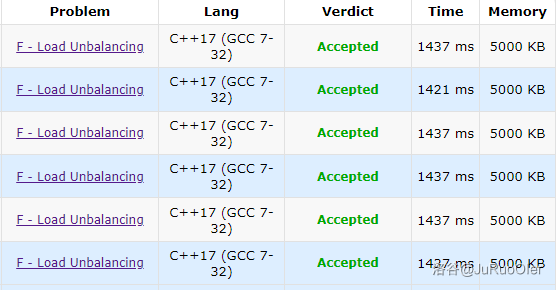
而 CF 的这位佬想了另一个办法:写一个类似爬山的东西,即每次先 shuffle,然后枚举每个对,看看交换是否更优;然后每轮并行处理所有数据以方便卡时。但是那个佬称他 FST 了,故我将枚举对的过程也改成了随机顺序。经测,这个东西过的概率还挺大的:
:::info[Code]
```cpp
//Please ignore those headfiles.I write them just because
//DEV-C++ won't support completion if i use <bits/stdc++.h>
#include<iostream>
#include<cstdio>
#include<cstdlib>
#include<cstring>
#include<ctime>
#include<cmath>
#include<cctype>
#include<string>
#include<algorithm>
#include<vector>
#include<map>
#include<unordered_map>
#include<set>
#include<queue>
#define ll long long
#define ull unsigned long long
#define lf double
#define ld long double
#define LL __int128
#define ui unsigned int
using namespace std;
struct node{
ll n,k,a[20],b[20],ind[20],ans;
void init(){
cin>>n>>k;
for(int i=0;i<n;i++){
cin>>a[i];
ind[i]=i;
}
}
ll calc(){
ll mx=0;
memset(b,0,sizeof(b));
for(int i=0;i<n;i++){
ll mn=999999999999999999ll,mni=0;
for(int j=0;j<k;j++){
if(b[j]<mn){
mn=b[j];
mni=j;
}
}
b[mni]+=a[i];
mx=max(mx,b[mni]);
}
return mx;
}
void proc(){
random_shuffle(a,a+n);
random_shuffle(ind,ind+n);
ll now=calc();
for(int i=0;i<n;i++){
for(int j=i+1;j<n;j++){
swap(a[ind[i]],a[ind[j]]);
ll tmp=calc();
if(tmp>now){
now=tmp;
}
else{
swap(a[ind[i]],a[ind[j]]);
}
}
}
ans=max(ans,now);
}
};
node a[10010];
ll T;
int main(){
ios::sync_with_stdio(0);
srand(time(0));
cin>>T;
for(int i=0;i<T;i++){
a[i].init();
}
while(clock()*1.0/CLOCKS_PER_SEC<1.4){
for(int i=0;i<T;i++){
a[i].proc();
}
}
for(int i=0;i<T;i++){
cout<<a[i].ans<<endl;
}
return 0;
}
```
:::