矩阵乘法与矩阵快速幂
UKE_Automation
·
·
算法·理论
1 矩阵乘法
1.1 定义
对于两个矩阵 A,B,其中 A 大小为 n\times m ,B 大小为 m\times p,则这两个矩阵可以做乘法,得到的矩阵 C 的大小为 n\times p。
例如:
A=\begin{bmatrix}
a_{11} & a_{12} & a_{13}\\
a_{21} & a_{22} & a_{23}
\end{bmatrix}
B=\begin{bmatrix}
b_{11} & b_{12}\\
b_{21} & b_{22}\\
b_{31} & b_{32}
\end{bmatrix}
则有:
C=AB=\begin{bmatrix}
a_{11} & a_{12} & a_{13}\\
a_{21} & a_{22} & a_{23}
\end{bmatrix}\begin{bmatrix}
b_{11} & b_{12}\\
b_{21} & b_{22}\\
b_{31} & b_{32}
\end{bmatrix}=\begin{bmatrix}
a_{11}b_{11}+a_{12}b_{21}+a_{13}b_{31} & a_{11}b_{12}+a_{12}b_{22}+a_{13}b_{32}\\
a_{21}b_{11}+a_{22}b_{21}+a_{23}b_{31} & a_{21}b_{12}+a_{22}b_{22}+a_{23}b_{32}
\end{bmatrix}
1.2 注意点
- 只有当矩阵 A,B 满足 A 的列数等于 B 的行数时,才能进行矩阵乘法。
- 矩阵乘法不满足交换律(这点很重要)
1.3 代码
提供一个封装模板。
#include <bits/stdc++.h>
#define int long long

using namespace std;

typedef long long LL;
const int Maxn = 205;

int n, m, p;

struct matrix {
    int n, m, p[Maxn][Maxn];
    matrix operator * (const matrix &b) const {
        matrix a = *this, c;
        c.n = a.n, c.m = b.m;
        for(int i = 1; i <= a.n; i++) {
            for(int j = 1; j <= a.m; j++) {
                for(int k = 1; k <= b.m; k++) {
                    c.p[i][k] += a.p[i][j] * b.p[j][k];
                }
            }
        }
        return c;
    }
    void print() {
        for(int i = 1; i <= n; i++) {
            for(int j = 1; j <= m; j++) {
                cout << p[i][j] << " ";
            }
            cout << '\n';
        }
    }
}A, B, C;

signed main() {
    ios::sync_with_stdio(0);
    cin >> n >> m;
    A.n = n, A.m = m;
    for(int i = 1; i <= n; i++) {
        for(int j = 1; j <= m; j++) {
            cin >> A.p[i][j];
        }
    }
    cin >> p;
    B.n = m, B.m = p;
    for(int i = 1; i <= m; i++) {
        for(int j = 1; j <= p; j++) {
            cin >> B.p[i][j];
        }
    }
    C = A * B;
    C.print();
    return 0;
}
2 矩阵快速幂
2.1 定义
仿照着数字的快速幂,我们也能快速求出矩阵的幂。
定义矩阵的幂为:A^n=A\cdot A\cdot A\cdot A\cdots
这很明显需要满足原矩阵为正方形。
2.2 用途
矩阵快速幂的经典应用就是加速递推。
直接举几个例子。
2.2.1 「例 1」Fibonacci 第 n 项
Problem
求斐波那契数列第 n 项后四位(n\le10^9)
Solution
第一眼:这不是递推板题吗!
然而 n\le10^9,O(n) 暴力绝对爆炸。
我们运用矩阵快速幂加速递推。
接下来我们来求一下递推式(注意掌握方法):
$$
\begin{bmatrix}
F_n \\
\ \
\end{bmatrix}
=
\begin{bmatrix}
1 & 1\\
\ & \
\end{bmatrix}
\begin{bmatrix}
F_{n-1} \\
F_{n-2}
\end{bmatrix}
$$
$②$ 接下来我们关注右边的第二个矩阵,发现他们的下标相差 $1$,因此左边的矩阵应该是 $\begin{bmatrix}
F_n \\
F_{n-1}
\end{bmatrix}$ 。
$③$ 最后补全整个式子:
$$
\begin{bmatrix}
F_n \\
F_{n-1} \
\end{bmatrix}=\begin{bmatrix}
1 & 1\\
1 & 0
\end{bmatrix}\begin{bmatrix}
F_{n-1} \\
F_{n-2}
\end{bmatrix}
$$
因此我们对于矩阵 $\begin{bmatrix}
1 & 1\\
1 & 0
\end{bmatrix}$ 不断做快速幂,然后乘上 $\begin{bmatrix}
F_{1} \\
F_{0}
\end{bmatrix}$ 即可。
**Code**
```cpp
#include <bits/stdc++.h>
#define int long long
using namespace std;
typedef long long LL;
const int Maxn = 205;
int n, mod;
struct matrix {
int n, m, p[Maxn][Maxn];
void init() {
n = 0, m = 0, memset(p, 0, sizeof p);
}
matrix operator * (const matrix &b) const {
matrix a = *this, c;
c.init();
c.n = a.n, c.m = b.m;
for(int i = 1; i <= a.n; i++) {
for(int j = 1; j <= a.m; j++) {
for(int k = 1; k <= b.m; k++) {
c.p[i][k] = (c.p[i][k] + a.p[i][j] * b.p[j][k] % mod) % mod;
}
}
}
return c;
}
matrix operator ^ (const int &o) const {
matrix res, a = *this; int b = o;
res.init();
res.n = res.m = 2;
res.p[1][1] = res.p[2][2] = 1;
while(b) {
if(b & 1) {
res = res * a;
}
a = a * a;
b >>= 1;
}
return res;
}
void print() {
for(int i = 1; i <= n; i++) {
for(int j = 1; j <= m; j++) {
cout << p[i][j] << " ";
}
cout << '\n';
}
}
}A;
signed main() {
ios::sync_with_stdio(0);
cin >> n >> mod;
A.p[1][1] = A.p[1][2] = A.p[2][1] = 1;
A.n = A.m = 2;
A = A ^ (n - 1);
cout << A.p[1][1];
return 0;
}
```
### 2.2.2 「例 2」P207 迷路
**Solution**
我们发现如果边权为 $1$ ,那么直接将矩阵 $T$ 次方即可。
但是此时边权不为 $1$,所以不能这样做。
但是我们又会发现这个边权居然最高才 $9$,因此我们考虑一下分层图的思路。
将一个点拆成 $9$ 个点并顺次相连,这样能将边权转化为 $1$。举个例子:
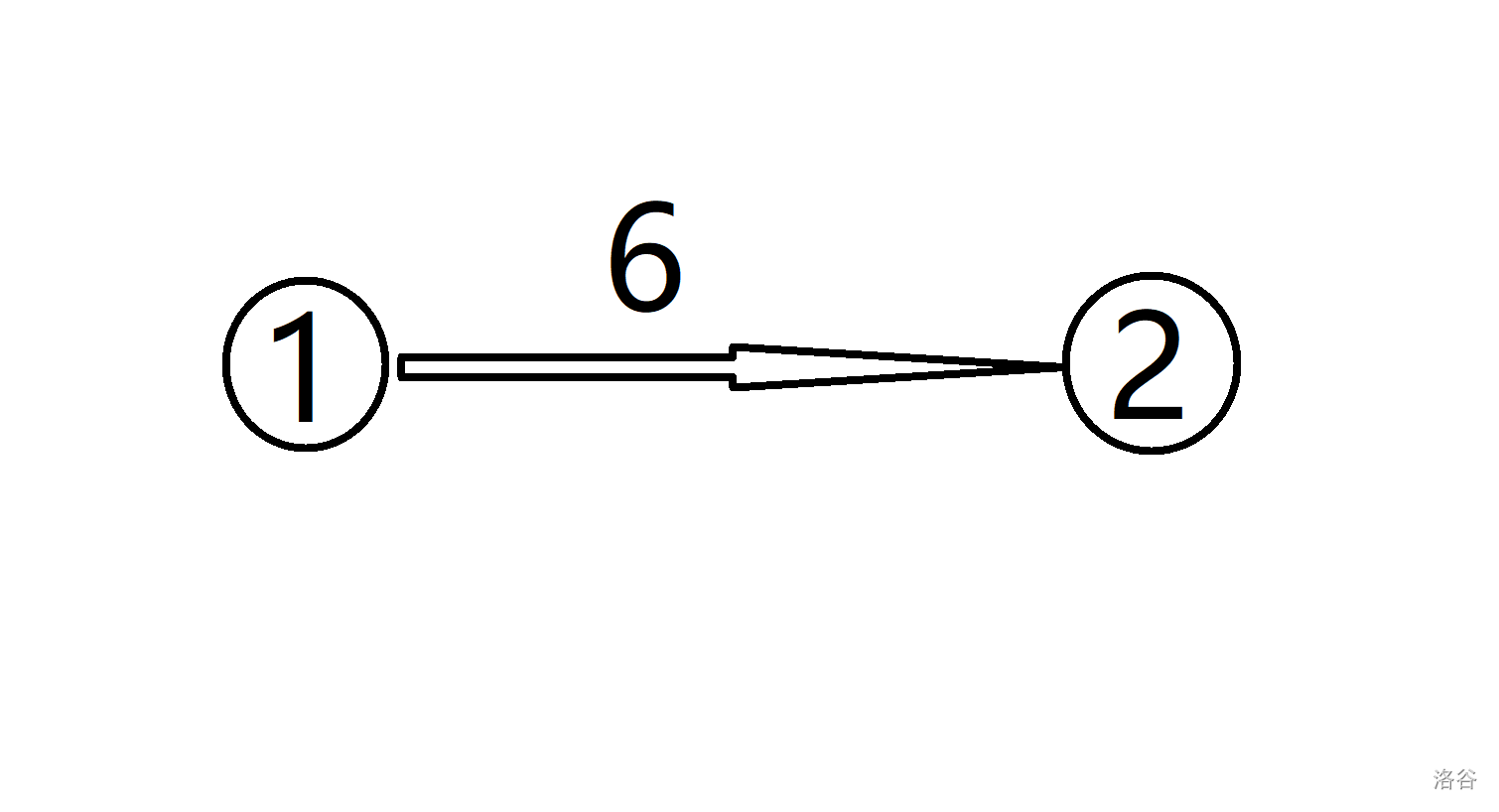
对于这样一条边,我们将 $1$ 和 $2$ 两个点拆开,然后将他们按照原先边权连起来,如下图:
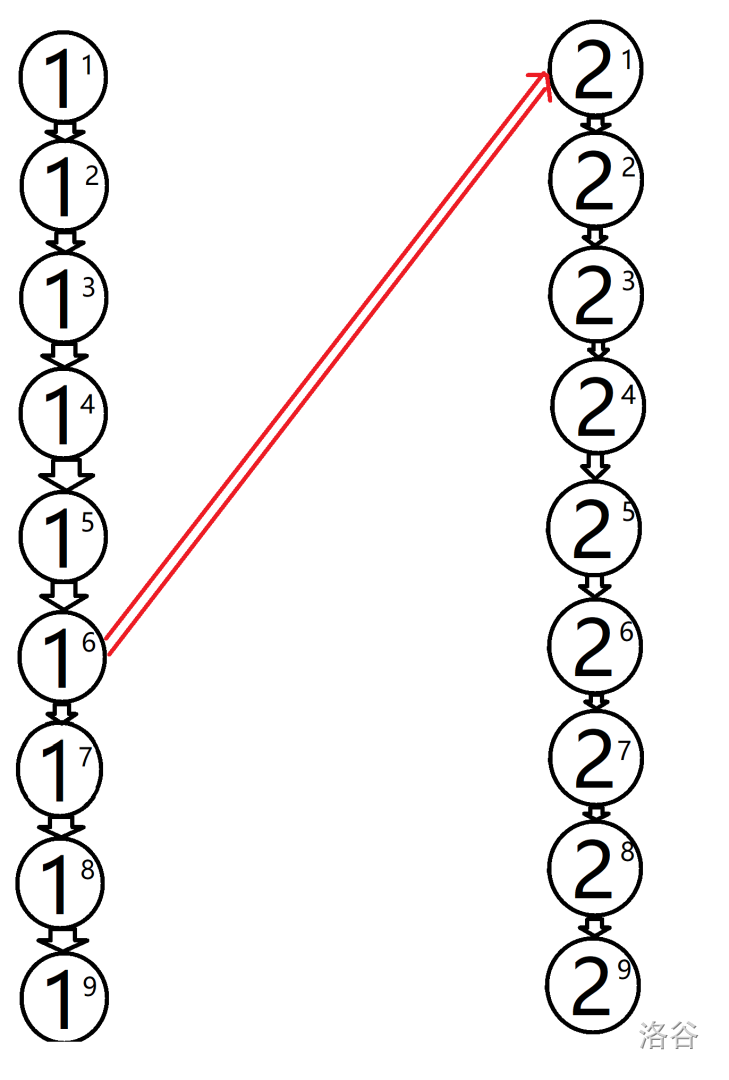
这样从 $1_1$ 走到 $2_1$,经过的边权仍然是 $6$,但我们就转化成了边权为 $1$ 的图。
注意最后统计答案时统计的是点 $n_1$ 的值而非 $n$ 的所有值的和。
接下来注意细节即可。
**Code**
```cpp
#include <bits/stdc++.h>
/*
我们发现如果边权为 1,那就是一道求 t 次方的大板子题
然而这题有边权,所以不能这么干
我们考虑分层图的思想,既然边权才 9,那我们直接将一个点暴力拆成九个点,然后边权就能转化为 1
这下就是大板子题了,在求 t 次方即可
*/
using namespace std;
typedef long long LL;
const int Maxn = 205;
const int Mod = 2009;
int n, t, m;
struct matrix {
int n, m, p[Maxn][Maxn];
void init() {
n = 0, m = 0, memset(p, 0, sizeof p);
}
matrix operator * (const matrix &b) const {
matrix a = *this, c;
c.init();
c.n = a.n, c.m = b.m;
for(int i = 1; i <= a.n; i++) {
for(int j = 1; j <= a.m; j++) {
for(int k = 1; k <= b.m; k++) {
c.p[i][k] = (c.p[i][k] + a.p[i][j] * b.p[j][k] % Mod) % Mod;
}
}
}
return c;
}
matrix operator ^ (const int &o) const {
matrix res, a = *this; int b = o;
res.init();
res.n = res.m = a.n;
for(int i = 1; i <= n; i++) {
res.p[i][i] = 1;
}
while(b) {
if(b & 1) {
res = res * a;
}
a = a * a;
b >>= 1;
}
return res;
}
void print() {
for(int i = 1; i <= n; i++) {
for(int j = 1; j <= m; j++) {
cout << p[i][j] << " ";
}
cout << '\n';
}
}
}A;
signed main() {
ios::sync_with_stdio(0);
cin >> n >> t;
m = n * 9;
for(int i = 1; i <= n; i++) {
for(int j = 1; j <= 8; j++) {
A.p[9 * (i - 1) + j][9 * (i - 1) + j + 1] = 1;
}
}
for(int i = 1; i <= n; i++) {
for(int j = 1; j <= n; j++) {
char ch;
cin >> ch;
if(ch > '0') {
A.p[9 * (i - 1) + ch - '0'][9 * (j - 1) + 1] = 1;
}
}
}
A.n = A.m = m;
A = A ^ t;
cout << A.p[1][9 * (n - 1) + 1];
return 0;
}
```
### 2.2.3 「例 3」佳佳的 Fibonacci
**Problem**
求 $(F_1+2F_2+3F_3+\cdots+nF_n)\bmod{m}$ 的值。
**Solution**
我们还是运用矩阵快速幂。
但是我们发现这个形式似曾相识,还记得求区间修改区间查询的 BIT 时候的式子吗?他和这个形式是一样的。
我们还是再来推一遍:
先设 $S_i=F_1+F_2+\cdots+F_i
然后有:
\begin{aligned}&F_1+2F_2+3F_3+\cdots+nF_n\\&=n\times S_n-S_{n-1}-S_{n-2}-\cdots-S_1\\&=n\times S_n-\sum_{i=1}^{n-1}S_i \end{aligned}
然后我们再令 P_n=\sum_{i=1}^{n-1}S_i ,则此时原式就可以化为:
n\times S_n-P_n
接下来我们递推 S_n,P_n 来得到原式。
还是分步讨论:
$\begin{bmatrix}
P_n \\
\ \\
\ \\
\
\end{bmatrix}=\begin{bmatrix}
1 & 1 & 0 & 0\\
\ & \ & \ &\ \\
\ & \ & \ &\ \\
\ & \ & \ &\
\end{bmatrix}\begin{bmatrix}
P_{n-1} \\
S_{n-1} \\
\ \\
\
\end{bmatrix}
$\begin{bmatrix}
P_n \\
S_n \\
\ \\
\
\end{bmatrix}=\begin{bmatrix}
1 & 1 & \ &\ \\
0 & 1 & 1 &\ \\
\ &\ & \ & \ \\
\ & \ & \ &\
\end{bmatrix}\begin{bmatrix}
P_{n-1} \\
S_{n-1} \\
F_n \\
\
\end{bmatrix}
$\begin{bmatrix}
P_n \\
S_n \\
F_{n+1} \\
F_n
\end{bmatrix}=\begin{bmatrix}
1 & 1 & 0 & 0 \\
0 & 1 & 1 & 0 \\
0 & 0 & 1 & 1\\
0 & 0 & 1 & 0
\end{bmatrix}\begin{bmatrix}
P_{n-1} \\
S_{n-1} \\
F_n \\
F_{n-1}
\end{bmatrix}
然后实现即可。
Code
十年 OI 一场空,不开 long long 见祖宗。
#include <bits/stdc++.h>
#define int long long

using namespace std;

typedef long long LL;
const int Maxn = 205;

int n, mod;

struct matrix {
    int n, m, p[Maxn][Maxn];
    void init() {
        n = m = 0;
        memset(p, 0, sizeof p);
    }
    void print() {
        for(int i = 1; i <= n; i++) {
            for(int j = 1; j <= m; j++) {
                cout << p[i][j] << " ";
            }
            cout << '\n';
        }
    }
    matrix operator * (const matrix &b) const {
        matrix a = *this, c;
        c.init();
        c.n = a.n, c.m = b.m;
        for(int i = 1; i <= a.n; i++) {
            for(int j = 1; j <= a.m; j++) {
                for(int k = 1; k <= b.m; k++) {
                    c.p[i][k] = (c.p[i][k] + a.p[i][j] * b.p[j][k] % mod) % mod;
                }
            }
        }
        return c;
    }
    matrix operator ^ (const int &b) const {
        int p = b;
        matrix a = *this, res;
        res.init();
        res.n = res.m = a.n;
        for(int i = 1; i <= a.n; i++) {
            res.p[i][i] = 1;
        }
        while(p) {
            if(p & 1) {
                res = res * a;
            }
            a = a * a;
            p >>= 1;
        }
        return res;
    }
}A, F;

signed main() {
    ios::sync_with_stdio(0);
    cin >> n >> mod;
    A.init(), F.init();
    A.n = A.m = 4;
    A.p[1][1] = A.p[1][2] = A.p[2][2] = A.p[2][3] = A.p[3][3] = A.p[3][4] = A.p[4][3] = 1;
    F.n = 4, F.m = 1;
    F.p[3][1] = 1;
    A = A ^ n;
    A = A * F;
    cout << (n * A.p[2][1] % mod - A.p[1][1] + mod) % mod;
    return 0;
}