P1395 会议 讲解
mairuisheng
·
·
算法·理论
设 sum_x 是节点 x 与节点 x 的子树的节点的数量之和,设节点 y_1\dots y_t 是节点 x 的儿子,设节点 u 是 x 的父亲。
具体来说,$sum_x=\sum_{i=1}^{t}sum_{y_i}$,即 $x$ 儿子的节点之和,这样递归求解即可。
又设 $dp_x$ 是当会议节点 $x$ 举行时,所有点到 $x$ 的路程之和。
分两种情况计算 $dp_x$:
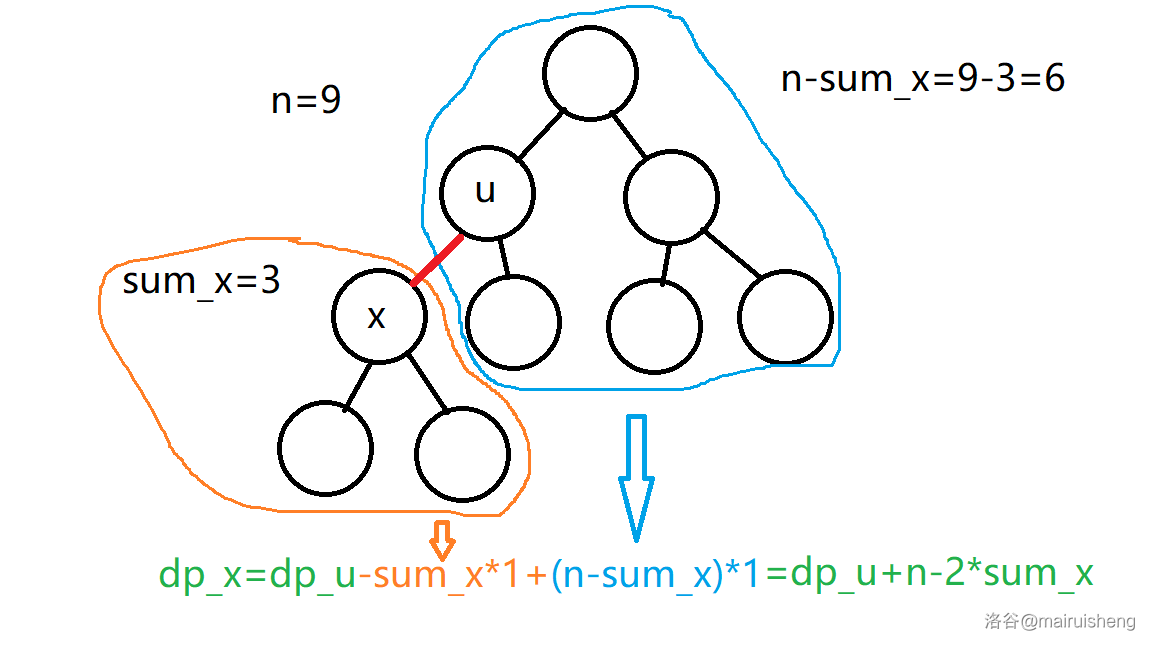
先把 $dp_u$ 的值赋值给 $dp_x$,即现在 $dp_x$ 存的是所有节点到 $dp_u$ 的距离之和。
①在 $x$ 子树的节点:
此时需减去 $sum_x$,因为每个 $x$ 子树的节点到 $x$ 的距离都比到 $u$ 节点少 $1$。
②不在 $x$ 子树的节点:
首先,不在 $x$ 子树的节点数为 $n-sum_x$,即总节点数减去子树节点个数。
然后,不在 $x$ 子树的节点想到 $x$ 必须经过 $u$,又因为 $x$ 和 $u$ 的距离是 $1$,所以需要累加 $n-sum_x$。
合并后得 $dp_x=dp_u+n-2\times sum_x$。
答案为 $dp_1\dots dp_n$ 的最小值。
- 时间复杂度:$O(n)$。
- 注意事项:
**如果有多个符合条件的,输出编号最小的那一个**,所以,在统计答案时需要比较编号大小。
还有,$dp_1=\sum_{i=2}^{n}sum_i$。
- 参考代码:
```cpp
//#pragma GCC optimize(3)
#include<cstdio>
#include<vector>
using namespace std;
inline int read()
{
int x=0,f=1;
char s;
s=getchar();
while(s<48||s>57)
{
if(s=='-')f=-f;
s=getchar();
}
while(s>47&&s<58)
{
x=(x<<3)+(x<<1)+(s-48);
s=getchar();
}
return x*f;
}
constexpr int N=5e4+1;
int n;
vector<int> g[N];
int sum[N],dp[N];
int id=1e9,ans=1e9;
int dfs(int u,int fa)//求sum数组
{
int i,son;
for(i=0;i<g[u].size();++i)
{
son=g[u][i];
if(fa==son)continue;
sum[u]+=dfs(son,u);
}
sum[u]++;
if(u>1)dp[1]+=sum[u];
return sum[u];
}
int min(int x,int y)
{
return x<y?x:y;
}
void DP(int u,int fa)//求dp数组
{
if(ans>dp[u])
{
id=u;
ans=dp[u];
}
if(dp[u]==ans)id=min(id,u);
int i,son;
for(i=0;i<g[u].size();++i)
{
son=g[u][i];
if(son==fa)continue;
dp[son]=dp[u]+sum[1]-(sum[son]<<1);
DP(son,u);
}
}
int main()
{
n=read();
int x,y,i;
for(i=1;i<n;++i)//建边
{
x=read();
y=read();
g[x].push_back(y);
g[y].push_back(x);
}
dfs(1,1);
DP(1,1);
printf("%d %d",id,ans);//编号以及最小值
return 0;
}
```