导数与积分
jsdw
·
2025-09-01 19:36:31
·
学习·文化课
导数基本概念
定义
定义函数 f(x) 的导数 f'(x)
f'(x)=\lim_{\Delta x\rarr 0}\frac{f(x+\Delta x)-f(x)}{\Delta x}
除了 f'(x) ,导数还常常写成 \displaystyle y'(x),\frac{\text dy}{\text dx},\frac{\text df}{\text dx},\frac{\text d}{\text dx}f(x) 。
几何定义:在函数 y=f(x) 的图像上取一点 A ,当自变量 x 有一个增量 \Delta x ,则函数值 y 也有一个增量 \Delta y ,则这时会对应一个点 B(x+\Delta x,y+\Delta y) 。当 x\rarr 0 时,直线 AB 会变成函数图像在 A 点的切线,这时函数在 A 点切线的斜率 k 就等于函数在 A 点的导数,即
k=\lim_{\Delta x\rarr 0}\frac{\Delta y}{\Delta x}=f'(x)=\frac{\text dy}{\text dx}
常用函数的导数
常值函数 f(x)=C ,导数 f'(x)=0 。
幂函数 f(x)=x^n ,导数 f'(x)=nx^{n-1} 。
指数函数 f(x)=a^x ,导数 f'(x)=a^x\ln a ,当 a=e 时,f'(x)=e^x 。
对数函数 f(x)=\log_a x ,导数 f'(x)=\displaystyle\frac{1}{x\ln a} ,当 a=e 时,f'(x)=\displaystyle\frac{1}{x} 。
三角函数 f(x)=\sin x ,导数 f'(x)=\cos x ;三角函数 f(x)=\cos x ,导数 f'(x)=-\sin x 。
导数的四则运算
若 f,g 都为可导函数,\alpha,\beta 都为常数,则
(\alpha f+\beta g)'=\alpha f'+\beta g'\\
(fg)'=f'g+fg'
若对于定义域内的 x 都满足 g(x)\ne 0 ,则
\left(\frac{f}{g}\right)'=\frac{f'g-fg'}{g^2}
练习
求下列函数的导数:
(1) x^3+\cos x ;
(2) \displaystyle\frac{1}{x}-\frac{1}{\sqrt x} ;
(3) x\sqrt x-\ln x ;
(4) (2x+3)^2 .
解析:
直接套表和运算法则即可。
(1) f'=3x^2-\sin x ;
(2) \displaystyle f'=(x^{-1}-x^{-\frac{1}{2}})'=-x^{-2}-(-\frac{1}{2})x^{-\frac{3}{2}}=-\frac{1}{x^2}+\frac{1}{\sqrt{x^3}} ;
(3) \displaystyle f'=(x^{\frac{3}{2}}-\ln x)'=\frac{3}{2}x^{\frac{1}{2}}-\frac{1}{x}=\frac{3\sqrt x}{2}-\frac{1}{x} ;
(4) f'=\left((2x+3)^2\right)'=(4x^2+12x+9)'=8x+12 .
复合函数求导
若函数 y=f[g(x)] 是由函数 y=f(u) 和 u=g(x) 复合而成,则 f'(x)=f'(u)\cdot g'(x) 。
或者说 \displaystyle\frac{\text dy}{\text dx}=\frac{\text dy}{\text du}\cdot \frac{\text du}{\text dx} 。
反函数求导
对于函数 y=f(x) ,若它的反函数为 x=f^{-1}(y) ,则 \left(f^{-1}(y)\right)'=\displaystyle\frac{1}{f'(x)} 。也就是说,反函数的导数与原函数的导数互为倒数。
高阶导数
称函数 f(x) 的导数 f'(x) 的导数 f''(x) 为 f(x) 的二阶导数,依此类推。为了方便,我们将 f(x) 的 n 阶导数记作 f^{(n)}(x) 或 \displaystyle\frac{\text d^nf}{\text dx^n} 。
练习
求:
---
解析:
先求 $(e^{ax})'$,设 $f(u)=e^u,g(x)=ax$,则 $(e^{ax})'=f(g(x))$,根据复合函数求导法则,$f(x)'=f(u)'\cdot g(x)'=e^u\cdot a=ae^{ax}$,所以说 $(a^{ex})^{(n)}=a\cdot (e^{ax})^{(n-1)}=a^n\cdot e^{ax}$。
# 导数的应用
## 求函数的极值
对于一个函数 $f(x)$,若 $\exist \sigma>0$,使得 $\forall x\in (x_0-\sigma,x_0+\sigma)$ 都有 $f(x)\le f(x_0)$,则 $x_0$ 为函数 $f(x)$ 的极大值点,反之则为极小值点,像下图这样:
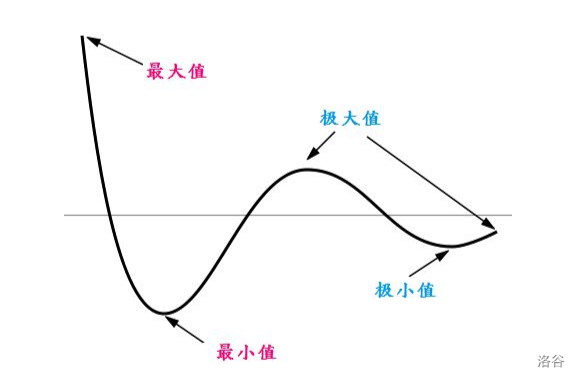
不难看出,若 $x$ 为函数 $f(x)$ 的极值点,则 $f'(x)=0$。
## 泰勒展开
泰勒展开具体如下:
$$
f(x)\approx\sum_{i=0}^n \frac{1}{i!}f^{(i)}(x_0)\cdot (x-x_0)^i
$$
当 $n$ 越大时,值就越精确,我们通常用函数的二阶近似展开式,即
$$
f(x)\approx f(x_0)+f'(x_0)\cdot (x-x_0)+\frac{1}{2}f''(x_0)\cdot (x-x_0)^2
$$
常用泰勒展开结果:
| 函数 | 泰勒展开结果 |
|:---:|:---:|
| $(1+x)^n$ | $1+nx$ |
| $\sin x,\tan x$ | $x$ |
| $\cos x$ | $1-\displaystyle\frac{x^2}{2}$ |
| $e^x$ | $1+x$ |
| $\ln(1+x)$ | $x$ |
## 练习
将 $f(x)=\sqrt{1+x+x^2}$ 在 $x=0$ 附近展开到 $x$ 的二阶项 .
---
解析:
先求导:$f'(x)=\displaystyle\frac{2x+1}{2\sqrt{x^2+x+1}},f''(x)=\frac{3\sqrt{x^2+x+1}}{4(x^4+2x^3+3x^2+2x+1)}$。
然后泰勒展开:
$$
f(x)=f(0)+f'(0)\cdot (x-0)+\frac{1}{2}f''(0)\cdot (x-0)^2\newline
=1+\frac{1}{2}x+\frac{1}{2}\cdot \frac{3}{4}x^2\newline
=1+\frac{1}{2}x+\frac{3}{8}x^2
$$
# 定积分
## 含义
$$
\int_a^b f(x)\text dx=\lim_{\Delta x\rarr 0}\sum_{i=1}^n f(x_i)\Delta x_i
$$
其中 $f(x)$ 为被积函数,$x$ 为积分变量,$f(x)\text dx$ 为被积表达式,$a,b$ 分别为积分下限与上限,定积分实际上就是小量求和。
## 牛顿-莱布尼兹公式
若 $F(x)'=f(x)$,则
$$
\int_a^b f(x)\text dx=F(b)-F(a)
$$
## 定积分运算法则
上下限相等及交换运算:
当定积分上下限相同时,即 $a=b$ 时,
$$
\int_a^b f(x)\text dx=0
$$
当 $a>b$ 时,
$$
\int_a^b f(x)\text dx=-\int _b^a f(x)\text dx
$$
---
线性运算:
对于任意常数 $\alpha,\beta$,$\alpha f+\beta g$ 也是 $[a,b]$ 上的可积函数,且
$$
\int_a^b [\alpha f(x)+\beta g(x)]\text dx=\alpha\int_a^b f(x)\text dx+\beta \int_a^b g(x)\text dx
$$
---
定积分拆分:
对于一个数 $c$,若 $a<c<b$,则
$$
\int_a^b f(x)\text dx=\int _a^c f(x)\text dx+\int_c^b f(x)\text dx
$$
## 练习
计算:
(1) $\displaystyle \int_0^\pi \sin x \text dx$ ;
(2) $\displaystyle \int_0^1 e^x \text dx$ .
---
解析:
套牛顿-莱布尼兹公式:
(1) $\displaystyle \int_0^\pi \sin x\text dx=-\cos \pi +\cos 0=2$ ;
(2) $\displaystyle \int_0^1 e^x \text dx=e^1-e^0=e-1$ .
# 不定积分
## 基本概念
函数 $f(x)$ 的原函数全体称作 $f(x)$ 的不定积分,记作 $\displaystyle \int f(x)\text dx$。即若 $F(x)=f'(x)$,则
$$
\int f(x)\text dx=F(x)+C
$$
其中 $C$ 为任意常数。由此可见,不定积分为求导的逆运算,即
$$
\left(\int f(x)\text dx\right)'=f(x)\newline
\int F'(x) \text dx=F(x)+C
$$
基本不定积分表:
$$
\int x^\alpha \text dx=\frac{1}{\alpha +1}x^{\alpha +1}+C,(\alpha \ne 1)\newline
\int \frac{1}{x}\text dx=\ln |x|+C\newline
\int a^x \text dx=\frac{1}{\ln a}a^x+C,(a>0,a\ne 1)\newline
\int e^x \text dx=e^x+C\newline
\int \sin x\text dx=-\cos x+C\newline
\int \cos x\text dx=\sin x+C\newline
\int \sec^2 x\text dx=\tan x+C\newline
\int \csc^2 x\text dx=-\cot x+C\newline
\int \sec x\tan x\text dx=\sec x+C\newline
\int \csc x\cot x\text dx=-\csc x+C\newline
\int \frac{1}{\sqrt{1-x^2}}\text dx=\arcsin x+C\newline
\int \frac{1}{1+x^2}\text dx=\arctan x+C
$$
不定积分的运算法则与求导的运算法则类似。
## 练习
计算:
(1) $\displaystyle \int \sqrt[3]{x}\text dx$ ;
(2) $\displaystyle \int \frac{1}{x^2}\text dx$ ;
(3) $\displaystyle \int s^{-1} \text ds$ ;
(4) $\displaystyle \int \frac{\text dx}{x^2\sqrt x}$ .
---
解析:
直接套表即可。
(1) $\displaystyle \int \sqrt[3]{x}\text dx=\frac{3}{4} x^{\frac{4}{3}}+C$ ;
(2) $\displaystyle \int \frac{1}{x^2}\text dx=\int x^{-2}\text dx=-x^{-1}+C=-\frac{1}{x}+C$ ;
(3) $\displaystyle \int s^{-1} \text ds=\ln |s|+C$ ;
(4) $\displaystyle \int \frac{\text dx}{x^2\sqrt x}=\int x^{-\frac{2}{5}} \text dx=-\frac{2}{3}x^{-\frac{3}{2}}+C=-\frac{2}{3\sqrt{x^3}}+C$ .
## 第一类换元积分
设 $F(x)'=f(x)$,令 $u=\varphi(x)$,则
$$
\int f(\varphi(x))\cdot \varphi'(x)\text dx=\int f(\varphi(x))\text d\varphi(x)=\int f(u)\text du=F(u)+C=F(\varphi(x))+C
$$
此方法的关键在于凑出 $\displaystyle \int f(\varphi(x))\cdot \varphi'(x)\text dx$。
## 练习
计算:
(1) $\displaystyle \int e^{3t}\text dt$ ;
(2) $\displaystyle \int (3-5x)^3\text dx$ .
---
解析:
(1) :
令 $x=3t$,则 $\text dx=3\text dt$,所以说:$\displaystyle\int e^{3t}\text dt=\int e^x\cdot \frac{1}{3}\text dx=\frac{1}{3}e^x+C$。
(2) :
令 $t=3-5x$,则 $\text dt=-5\text dx$,那么: $\displaystyle \int (3-5x)^3\text dx=\int t^3\cdot \left(-\frac{1}{5}\right)\text dt=-\frac{1}{20}t^4+C=-\frac{1}{20}(3-5x)^4+C$。
## 分步积分法
根据导数的公式,可得
$$
\int f(x)g'(x)\text dx=\int (f(x)g(x))'\text dx-\int f(x)'g(x)\text dx=f(x)g(x)-\int f'(x)g(x)\text dx
$$
---
挖一个坑:后续打算补充微分相关知识。