莫队学习笔记
沉石鱼惊旋
·
·
算法·理论
更好的阅读体验
蒸馍身边一群大神不会普通莫队。
现在每天半夜不写点根号算法都睡不着。根号算法个个是优雅的算法/se
莫队
处理离线区间询问。
名字由来是因为是莫涛整理的。
普通莫队
简介
可以较优复杂度从 [l\pm1,r\pm1] 转到 [l,r]。
当 n,q 同阶时,若转移为 \mathcal O(1),总复杂度即为 \mathcal O(n\sqrt n)。同理,转移为 \mathcal O(log n) 复杂度即为 \mathcal O(n\sqrt n\log n)。
<https://oi-wiki.org/misc/mo-algo/#%E5%A4%8D%E6%9D%82%E5%BA%A6%E5%88%86%E6%9E%90>
## 排序
对于询问的排序,一般是对 $L$ 分块,先按块排序,每个块内再按 $R$ 排序。一般这样即可,但是更好的写法可以继续奇偶性优化少掉不同块内 $R$ 从 $n$ 再次回到 $1$ 的过程。
以下为排序代码,其中 $fa_i$ 表示 $i$ 在那一块。
```cpp
bool cmp(node a, node b)
{
if (fa[a.L] != fa[b.L])
return a.L < b.L;
if (fa[a.L] & 1)
return a.R > b.R;
return a.R < b.R;
}
```
也就是说,不进行奇偶性优化的莫队,询问排序后长这样:
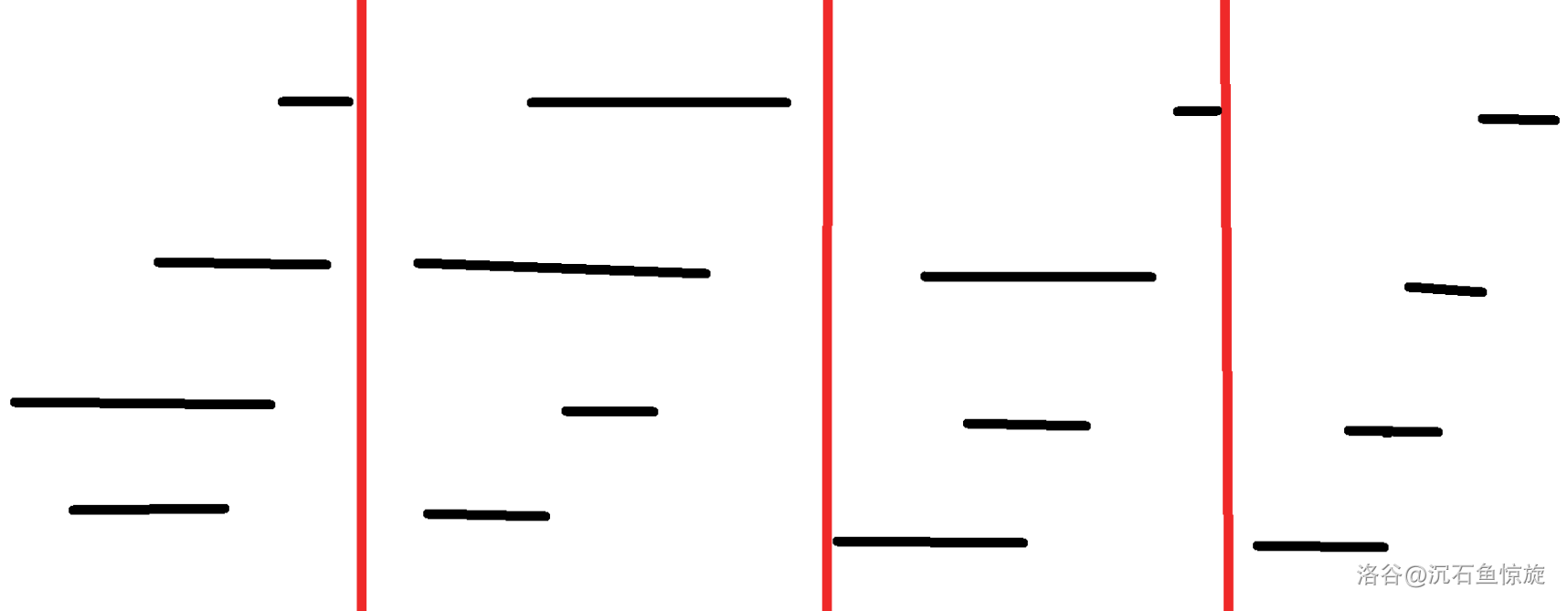
而进行了奇偶性优化的话:
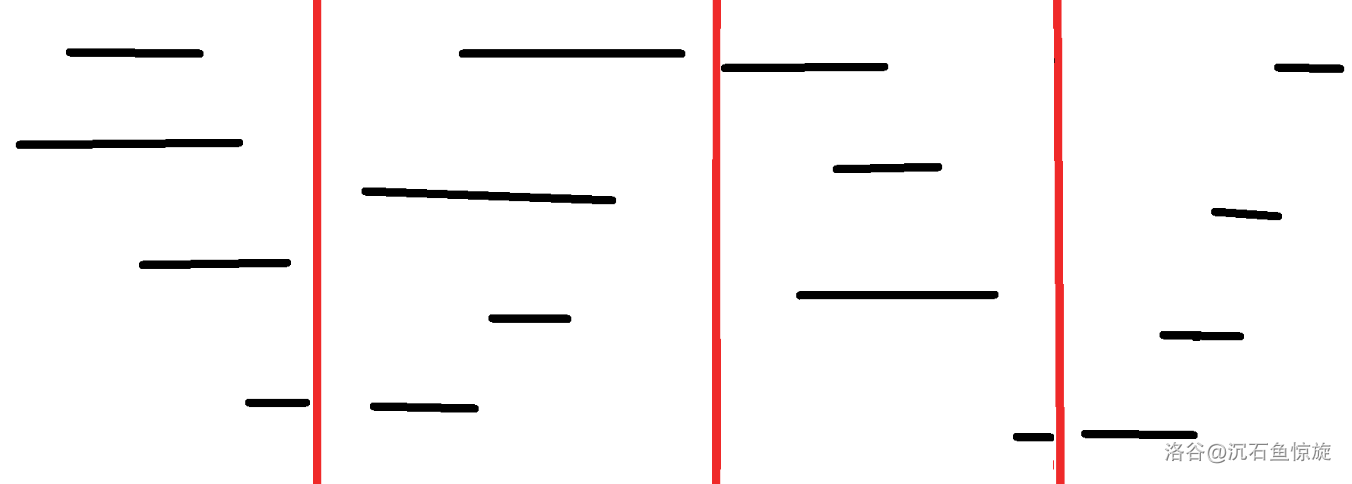
这样子就可以让 $R$ 更加连贯。
图中红线表示分块的界线,黑线表示区间询问范围。
## 实现
```cpp
int L = 1, R = 0;
for (int i = 1; i <= q; i++)
{
while (L > Query[i].L)
add(--L);
while (R < Query[i].R)
add(++R);
while (L < Query[i].L)
del(L++);
while (R > Query[i].R)
del(R--);
ans[Query[i].id] = ANS;
}
```
其中 $add(x)$ 和 $del(x)$ 分别表示添加第 $x$ 个位置和删除第 $x$ 个位置进行的操作。
当然,有的题 $L$ 和 $R$ 的添加删除是不一样的。
这是个循环位置的顺序,参考 <https://oi-wiki.org/misc/mo-algo/#%E8%BF%87%E7%A8%8B> 关于四个循环位置的讨论。一般来说你只要保证先扩张后缩减是不会有问题的。
## 例题
### [P1972 [SDOI2009] HH的项链](https://www.luogu.com.cn/problem/P1972)
我们将此题作为莫队模板进行讲解。
可是这题莫队标签都没有!那是因为大家不会卡常。
记录颜色数,即为记录 $h_i$ 表示 $i$ 在序列中出现的次数,新出现加一种颜色,被删完少一种颜色。
那么我们很快就能码好:
```cpp
#include <bits/stdc++.h>
using namespace std;
int fa[1000020];
int a[1000020];
int ans[1000020];
int h[1000020];
int n, len, ANS, q;
#define getchar() p1 == p2 && (p2 = (p1 = buf) + fread(buf, 1, 1000000, stdin), p1 == p2) ? EOF : *p1++
char buf[1000000], *p1 = buf, *p2 = buf;
inline int read()
{
register char c = getchar();
register int x = 0;
while (c < '0' || c > '9')
c = getchar();
while (c >= '0' && c <= '9')
x = (x << 1) + (x << 3) + (c ^ 48), c = getchar();
return x;
}
struct node
{
int L, R, id;
} Query[1000020];
bool cmp(node a, node b)
{
if (fa[a.L] != fa[b.L])
return a.L < b.L;
if (fa[a.L] & 1)
return a.R > b.R;
return a.R < b.R;
}
int main()
{
n = read();
len = sqrt(n);
for (int i = 1; i <= n; i++)
{
a[i] = read();
fa[i] = (i + len - 1) / len;
}
q = read();
for (int i = 1; i <= q; i++)
{
int L, R;
L = read();
R = read();
Query[i] = {L, R, i};
}
sort(Query + 1, Query + q + 1, cmp);
int L = 1, R = 0;
for (int i = 1; i <= q; i++)
{
while (L > Query[i].L)
ANS += (++h[a[--L]] == 1);
while (R < Query[i].R)
ANS += (++h[a[++R]] == 1);
while (L < Query[i].L)
ANS -= (--h[a[L++]] == 0);
while (R > Query[i].R)
ANS -= (--h[a[R--]] == 0);
ans[Query[i].id] = ANS;
}
for (int i = 1; i <= q; i++)
{
printf("%d\n", ans[i]);
}
return 0;
}
```
诶,T 了!本题莫队真的过不去吗?
我的评价是我这题不关同步的 cin 都过了。
```cpp
#include <bits/stdc++.h>
using namespace std;
int fa[1000020];
int a[1000020];
int ans[1000020];
int pre[1000020];
int nxt[1000020];
int p[1000020];
int n, len, ANS, q;
#define getchar() p1 == p2 && (p2 = (p1 = buf) + fread(buf, 1, 1000000, stdin), p1 == p2) ? EOF : *p1++
char buf[1000000], *p1 = buf, *p2 = buf;
inline int read()
{
register char c = getchar();
register int x = 0;
while (c < '0' || c > '9')
c = getchar();
while (c >= '0' && c <= '9')
x = (x << 1) + (x << 3) + (c ^ 48), c = getchar();
return x;
}
struct node
{
int L, R, id;
} Query[1000020];
bool cmp(node a, node b)
{
if (fa[a.L] != fa[b.L])
return a.L < b.L;
if (fa[a.L] & 1)
return a.R > b.R;
return a.R < b.R;
}
int main()
{
n = read();
len = sqrt(n);
for (int i = 1; i <= n; i++)
{
a[i] = read();
fa[i] = (i + len - 1) / len;
nxt[i] = n + 1;
pre[i] = p[a[i]];
nxt[pre[i]] = i;
p[a[i]] = i;
}
q = read();
for (int i = 1; i <= q; i++)
{
int L, R;
L = read();
R = read();
Query[i] = {L, R, i};
}
sort(Query + 1, Query + q + 1, cmp);
int L = 1, R = 0;
for (int i = 1; i <= q; i++)
{
while (L > Query[i].L)
ANS += (nxt[--L] > R);
while (R < Query[i].R)
ANS += (pre[++R] < L);
while (L < Query[i].L)
ANS -= (nxt[L++] > R);
while (R > Query[i].R)
ANS -= (pre[R--] < L);
ans[Query[i].id] = ANS;
}
for (int i = 1; i <= q; i++)
{
printf("%d\n", ans[i]);
}
return 0;
}
```
为什么这样可过呢,我们发现,观察一个数在序列中是否是只出现一次,只需要看同一颜色的数,是否已经出现过了。有点废话文学,但是『只需要看同一颜色的数,是否已经出现过了』就是记录这个数上一次出现的位置和下一次出现的位置。
所以,我们考虑记录 $pre_i$ 和 $nxt_i$ 表示 $a_i$ 上一次或下一次出现的位置用来辅助区间转移。
这样子就可以做到莫队过程访址连续,真正的 $\mathcal O(n\sqrt n)$。
### [P1494 [国家集训队] 小 Z 的袜子](https://www.luogu.com.cn/problem/P1494)
记录每个区间此时颜色数量,那么颜色数量 $-1$ 即为此时这个颜色能配成多少对。答案分母显然是 $\dbinom{R-L+1}{2}$。分子即为所有颜色能配成多少对。
### [P2709 小 B 的询问](https://www.luogu.com.cn/problem/P2709)
也是区间数颜色。每种颜色个数平方一下即可。
### [P3901 数列找不同](https://www.luogu.com.cn/problem/P3901)
判断区间颜色数是否 $=R-L+1$。
### [CF351D Jeff and Removing Periods](https://codeforces.com/problemset/problem/351/D)
为了方便描述,我们约定数值相同的数为同一颜色的数。
有 $n$ 个数,我们定义一次操作为:选择若干个同颜色数,使得他们在序列中的位置为一个等差数列。删除它们。
操作完之后可以重排整个序列。
有 $q$ 个询问,每次询问给定 $[l,r]$,求至少几次操作能全部删除 $[l,r]$。
询问互不影响。
$1\leq n,q,a_i\leq 10^5
http://blog.cyx2009.top/archives/250/ 查看。
或洛谷题解区最高赞题解。
ABC293G Triple Index
给定长度为 N 的数列 a_1,a_2,\cdots,a_N。
考虑增加颜色和删除颜色贡献,设当前位置的颜色是 $x$,共显示 $\pm \dfrac{(h_x-1)(h_x-2)}{2}$。其中 $h_i$ 表示颜色 $i$ 的个数。
### [TENKA1_2014_FINAL D](https://atcoder.jp/contests/tenka1-2014-final/tasks/tenka1_2014_final_d)
$m$ 组询问,每次给定 $n,k$,求 $\sum\limits_{i=0}^k \binom{n}{i}$。
$1 \le n, m, k \le 10^5$。
很好数学,爱来自莫队。
$\dbinom{n}{k-1}\to\dbinom{n}{k},ans\gets ans+\dbinom{n}{k}
\dbinom{n}{k+1}\to\dbinom{n}{k},ans\gets ans-\dbinom{n}{k+1}
\dbinom{n-1}{k}\to\dbinom{n}{k},ans\gets 2ans-\dbinom{n-1}{k}
\dbinom{n+1}{k}\to\dbinom{n}{k},ans\gets \dfrac{ans+\dbinom{n}{k}}{2}
改变 k 是显然的,改变 n 用帕斯卡法则拆一下即可得到 \dbinom{n-1}{k}\to\dbinom{n}{k} 的答案变化,另一个同理。
SP DQUERY - D-query
给出一个长度为 n 的数列,a_1,a_2,\dots,a_n ,有 q 个询问,每个询问给出数对(i,j),需要你给出 a_{i},a_{i+1},\dots ,a_{j} 这一段中有多少不同的数字。
也是区间数颜色。