[SP CNT3]
HeartlessWind
·
·
算法·理论
组合计数选讲 3
集合划分容斥
:::epigraph[我 at 2026-07-14 21:19]
我不会。
:::
来个简单易懂小例子做引入。
[ABC236Ex] Distinct Multiples
给定 N, M 和数组 \{D_N\},求有多少个正整数数组 \{A_N\} 满足:
-
-
- \bold{A_i\neq A_j},即数组两两不同。
:::info[Sol]
首先发现,没有第三条限制的情况是容易处理的。
对于第三条限制,考虑如果有一些数相等,会如何呢?
事实上,按“等于”这个关系连边,数组的位置被划分成若干“等价类”,即连通块。单个连通块的方案数是好求出的,为 $\lfloor\frac{M}{\operatorname{lcm}}\rfloor$。
如果你还是按连通块个数做斯特林反演,你就错了,这是因为:实际情况还原回按住情况,连通块会**分裂**,而不是**合并**。
合并的系数确实是第二类斯特林数,但是分裂的系数取决于连通块大小!有以下两个例子:
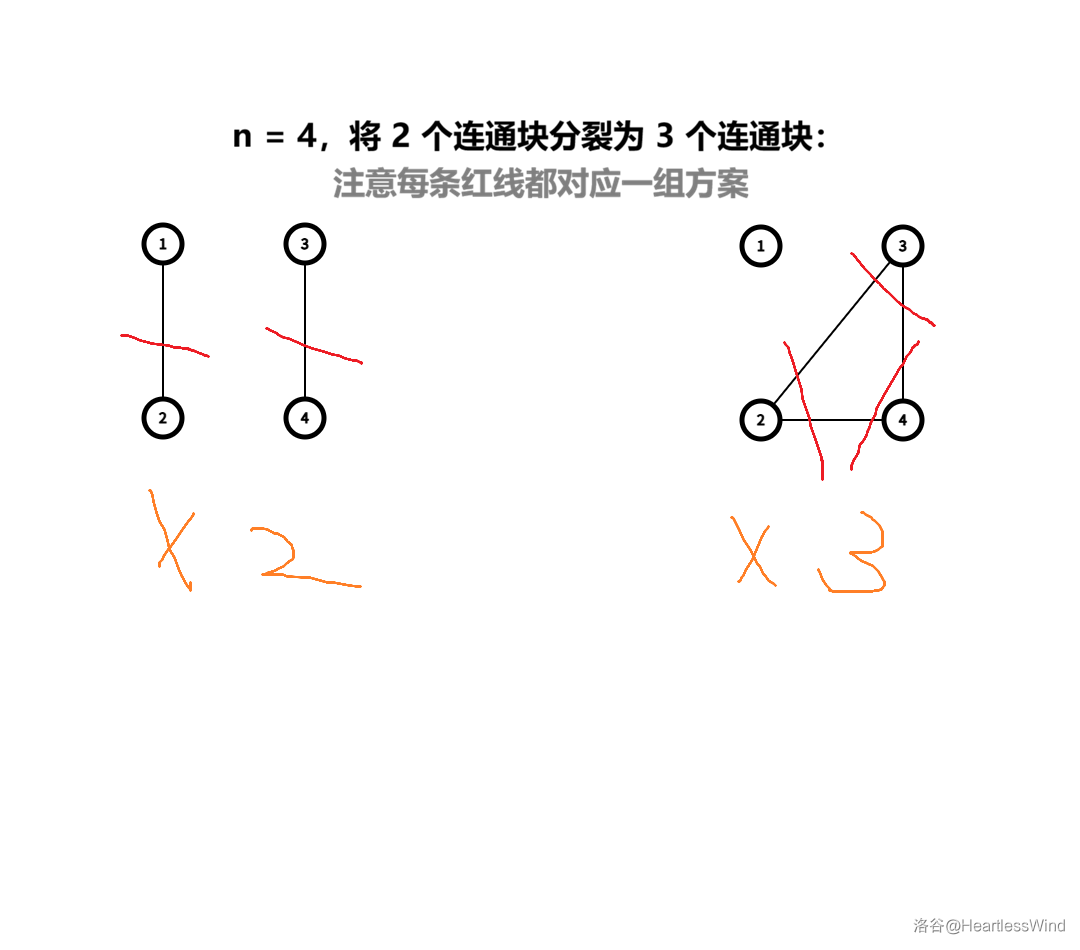
可以看出,方案数跟**连通块大小**还有关系!
那么,我们有其它方法吗?
考虑到连通块之间互相独立,那么,对于一张图,它对答案产生贡献,当且仅当所有连通块大小均为 1。
我们“按住”一些边,会分裂连通块,相当于直接划分。
对于大小为 $i$ 的普通图,其容斥系数和为 $g(i) = [i=1]$。不妨考虑大小为 $i$ 的,被我们按住的连通块,其容斥系数和为 $f(i)$。
对普通图枚举最小编号点所在连通块,有:
$$$
\begin{aligned}
g(i) &= \sum_{j=1}^{i} \binom{i-1}{j-1} f(j)g(i-j) \\
f(i) &= g(i) - \sum_{j=1}^{i-1} \binom{i-1}{j-1} f(j)g(i-j) \\
&= g(i) - (i-1)f(i-1) \\
&= (-1)^{i-1}(i-1)!
\end{aligned}
$$$
然后状压转移,枚举子集,就,做完了。
相信有聪明的小朋友发现 $f(i) = (-1)^{i-1}{i \brack 1}$,其实这个是 Rota 的偏序集上 Möbius 反演,我也看不懂。
:::
:::info[Code]
```cpp line-numbers
#include <bits/stdc++.h>
using std::cin;
using std::cout;
using ll = long long;
constexpr int N = 16, S = 1 << N, Mod = 998244353;
int n;
ll m, fac[N], d[N], w[S], dp[S];
int main() {
cin.tie(nullptr)->sync_with_stdio(false);
cin >> n >> m;
fac[0] = 1;
for (int i = 1; i < n; ++i) fac[i] = fac[i - 1] * i % Mod;
for (int i = 0; i < n; ++i) cin >> d[i];
// 按住相等的贡献
w[0] = 1;
for (int b = 1; b < (1 << n); ++b) {
auto x = w[b & (b - 1)];
auto i = __builtin_ctz(b);
if (x > m) {
w[b] = m + 1;
} else {
auto g = x / std::__gcd(x, d[i]);
w[b] = (g > m / d[i] ? m + 1 : g * d[i]);
}
}
// 乘上容斥系数 (-1)^{|S|-1}(|S|-1)! = (-1)^{|S|-1}Si(|S|,1)
for (int b = 1; b < (1 << n); ++b) {
auto s = __builtin_popcount(b);
w[b] = m / w[b] % Mod * (s & 1 ? 1 : Mod - 1) % Mod * fac[s - 1] % Mod;
}
/**
* 以下部分也可以写子集卷积,做到 \Theta(N^2 2^N)。
* 怕大家看不懂 FWT 不好水紫题!!!
**/
dp[0] = 1;
for (int p = 1; p < (1 << n); ++p)
for (int q = p; q; q = (q - 1) & p)
if ((p & -p) == (q & -q)) dp[p] = (dp[p] + dp[p ^ q] * w[q]) % Mod;
cout << dp[(1 << n) - 1];
}
```
:::
怎样转到一般图呢?
### [P6846 [CEOI 2019] Amusement Park](https://www.luogu.com.cn/problem/P6846)
给一个简单有向图。对某个反转边方案,如果反转后该图变为 DAG 则称这个方案合法。对所有合法反转边方案,求反转边个数和。
$n\leq 18$。
:::info[小转化]
某方案如果合法,全体再反转一次也合法。所以求合法方案个数,乘上边数再除以二就好了。
:::
:::info[Sol]
给 DAG 做拓扑排序一定要删空。
看上去很将军,但是不妨倒过来想,每次加一个入度为 0 的独立集就好了呀!
不过这个时候又发现和上面一样的问题,就是实际情况还原到按住情况,点集可能会分裂。
难住你了?
仿照上文,注意这次分裂出来的点集**有顺序**,发现 $g(i)=1$,所以
$$$
\begin{aligned}
g(i) &= \sum_{j=1}^{i} \binom{i}{j} f(j)g(i-j) \\
\texttt{I guess }f(i) &= (-1)^{i-1}
\end{aligned}
$$$
由于这个太容易看出来,详细推导请自行进行子集反演,题解区有一个。
:::
:::info[Code]
```cpp line-numbers
#include <bits/stdc++.h>
using std::cin;
using std::cout;
using ll = long long;
constexpr int N = 18, S = 1 << N, Mod = 998244353, Half = (Mod + 1) / 2;
inline constexpr int bitcrz(int x) { return __builtin_ctz(1u * x); }
inline constexpr int remlow(int x) { return x & (x - 1); }
inline constexpr int parity(int x) { return __builtin_parity(1u * x); }
inline void add(ll& x, ll y) { (x += y) >= Mod && (x -= Mod); }
int n, m, g[N];
bool ind[S];
ll dp[S];
int main() {
cin.tie(nullptr)->sync_with_stdio(false);
cin >> n >> m;
for (int i = 1, u, v; i <= m; ++i) {
cin >> u >> v;
--u;
--v;
g[u] |= (1 << v);
g[v] |= (1 << u);
}
ind[0] = true;
dp[0] = 1;
for (int s = 1; s < (1 << n); ++s) {
ind[s] = (ind[remlow(s)] && !(g[bitcrz(s)] & s));
for (int t = s; t; t = (t - 1) & s)
if (ind[t]) add(dp[s], parity(t) ? dp[s ^ t] : Mod - dp[s ^ t]);
}
cout << dp[(1 << n) - 1] * m % Mod * Half % Mod;
}
```
:::
### [P11714 [清华集训 2014] 主旋律](https://www.luogu.com.cn/problem/P11714)
该来的还是要来。
给一个简单有向图,求边集有多少个子集构成强连通图。
$n\leq 15$。
:::info[Sol]
强连通图缩 SCC 后大小一定要是 1。
那么依旧考虑对缩 SCC 后的 DAG 计数,每次加一个独立集。
数点集 $S$ 强连通的方案数 $f_S$,那么要减去 DAG 至少两个点的情况。
设 $g_S$ 为点集 $S$ 缩为独立集的方案数,那么
$$$
\begin{aligned}
f_S = 2^{|E(S, S)|} - \sum_{T\subseteq S} (-1)^{???}g_T 2^{|E(S, S\backslash T)|}+f_S
\end{aligned}
$$$
加上 $f_S$ 的原因是 $T=S$ 会把缩成一个点的方案减掉,我们简单加回来。
呃,合着 $g_T$ 要带系数 $(-1)^{|V'|-1}$。
设 $g_S$ 为点集 $S$ 缩为奇数个独立集的方案数,减去偶数个的方案数,那么
$$$
\begin{aligned}
f_S &= 2^{|E(S, S)|} - \sum_{T\subseteq S} g_T 2^{|E(S, S\backslash T)|}+f_S \\
g_S &= f_S - \sum_{T\subsetneq S \land \operatorname{lowbit}(S) = \operatorname{lowbit}(T)} g_{S\backslash T} 2^{|E(T, T)|} \\
f_S &= 2^{|E(S, S)|} - \sum_{T\subsetneq S} g_T 2^{|E(S, S\backslash T)|} + (f_S - g_S) \\
\end{aligned}
$$$
先算 $f_S - g_S$ 更新 $f_S$ 再更新 $g_S$ 即可。
至于 $2^{|E|}$ 属于状压基本功,固定 lowbit,不讲。
时间复杂度 $\Theta(3^n)$。
:::
:::info[Code]
```cpp
#include <bits/stdc++.h>
using std::cin;
using std::cout;
using ll = long long;
constexpr int N = 15, S = 1 << N, Mod = 1e9 + 7;
inline constexpr int bitcrz(int x) { return __builtin_ctz(1u * x); }
inline constexpr int lowbit(int x) { return x & -x; }
inline constexpr int remlow(int x) { return x & (x - 1); }
inline constexpr int popcnt(int x) { return __builtin_popcount(1u * x); }
inline void add(ll& x, ll y) { (x += y) >= Mod && (x -= Mod); }
int n, m, in[N], out[N], es[S], ec[S];
ll P2[N * N], g[S], dp[S];
int main() {
cin.tie(nullptr)->sync_with_stdio(false);
cin >> n >> m;
P2[0] = 1;
for (int i = 1; i <= m; ++i) P2[i] = 2 * P2[i - 1] % Mod;
for (int i = 1, u, v; i <= m; ++i) {
cin >> u >> v;
--u;
--v;
out[u] |= (1 << v);
in[v] |= (1 << u);
}
for (int s = 1; s < (1 << n); ++s) { {
auto u = bitcrz(s);
es[s] = es[remlow(s)] + popcnt(s & in[u]) + popcnt(s & out[u]); }
ec[s] = 0;
for (int t = remlow(s); t; t = (t - 1) & s) {
auto o = s ^ t, u = bitcrz(o);
ec[t] = ec[t ^ (1 << u)] + popcnt(t & in[u]) - popcnt(o & out[u]);
}
for (int t = remlow(s); t; t = (t - 1) & s)
if (lowbit(s) == lowbit(t)) add(g[s], dp[t] * g[s ^ t] % Mod);
g[s] = (g[s] ? Mod - g[s] : 0);
for (int t = s; t; t = (t - 1) & s)
add(dp[s], g[t] * P2[es[s ^ t] + ec[t]] % Mod);
add(g[s], dp[s] = (P2[es[s]] + Mod - dp[s]) % Mod);
}
cout << dp[(1 << n) - 1];
}
```
:::
### [P10104 [GDKOI2023 提高组] 异或图](https://www.luogu.com.cn/problem/P10104)
给定一张 $n$ 个点 $m$ 条边的无向图和数组 $\{a_n\}$ 以及整数 $C$,求有多少个数组 $\{b_n\}$ 满足:
- $0 ≤ b_i ≤ a_i,\forall 1 ≤ i ≤ n$;
- $\bigoplus_{i=1}^n b_i = C$;
- 对于每条边 $(u, v)$,$b_u \ne b_v$。
$n\leq 15$。
:::info[Sol]
对于 $m=0$,你要会做 [P3447 [POI 2006] KRY-Crystals](https://www.luogu.com.cn/problem/P3447)。
枚举连通块划分,则分奇偶讨论,都只关心块内最小值。
单个连通块的容斥系数是什么?自然是可能的 $(-1)^{|E|}$ 之和,要求 $E$ 端点全在 $S$ 内,且使得 $S$ 连通,原因是实际情况还原到按住情况依旧会裂开。
直接搜索划分没法过,所以按 $a_i$ 从小往大排序,再看搜索划分过程,转移时枚举等价类内最小元即可。
时间复杂度 $\Theta(3^n+2^n\log V)$。
:::
:::info[Code]
```cpp
#include <bits/stdc++.h>
namespace Hy {
using std::cin;
using std::cout;
using ull = std::uint64_t;
constexpr int N = 15, S = 1 << N, B = 61, Mod = 998244353, Half = (Mod + 1) >> 1;
inline void Add(ull& x, ull y) { (x += y) >= Mod && (x -= Mod); }
int n, m, g[N], _p[N], _q[N];
bool ind[S], ff[S];
ull pinv[B], C, a[N], se[S], w[2][S], dp[S][2], af[S], Ans;
int my_main() {
cin.tie(nullptr)->sync_with_stdio(false);
cin >> n >> m >> C;
pinv[0] = 1;
for (int i = 1; i < B; ++i) pinv[i] = pinv[i - 1] * Half % Mod;
for (int i = 0; i < n; ++i) cin >> a[i], ++a[i];
std::iota(_p, _p + n, 0);
std::sort(_p, _p + n, [](int l, int r) { return a[l] < a[r]; });
for (int i = 0; i < n; ++i) _q[_p[i]] = i;
std::sort(a, a + n);
for (int i = 0, u, v; i < m; ++i) {
cin >> u >> v;
u = _q[u - 1], v = _q[v - 1];
g[u] |= 1 << v;
g[v] |= 1 << u;
}
se[0] = ind[0] = 1;
for (int p = 1; p < (1 << n); ++p) {
ind[p] = ind[p & (p - 1)] && !(g[__builtin_ctz(p)] & p);
se[p] = ind[p];
for (int q = (p - 1) & p; q; q = (q - 1) & p)
if ((p & -p) == (q & -q) && ind[p ^ q]) Add(se[p], Mod - se[q]);
}
w[0][0] = 1;
for (int i = 0; i < n; ++i) {
auto &lst = w[i & 1], &now = w[~i & 1];
std::fill(now, now + (1 << n), 0);
for (int c = 0; c < (1 << i); ++c)
for (int b = 1 << (n - i - 1), p = 0; p < b; ++p) {
auto pre = c ^ (p << (i + 1));
Add(now[pre], lst[pre ^ (1 << i)]);
for (int un = p ^ (b - 1), q = un; ; q = (q - 1) & un) {
auto s = (1 << i) ^ (q << (i + 1));
auto prt = __builtin_parity(q) ^ 1;
auto nxt = c ^ (prt << i) ^ ((p ^ q) << (i + 1));
Add(now[nxt], se[s] * lst[pre] % Mod * (prt ? 1 : a[i] % Mod) % Mod);
if (!q) break;
}
}
}
auto &fin = w[n & 1];
std::fill(ind, ind + (1 << n), true);
for (int b = B; b--;) {
dp[0][0] = 1;
dp[0][1] = 0;
ff[0] = 0;
af[0] = 1;
auto p2 = (1ull << b) % Mod;
for (int p = 1; p < (1 << n); ++p) {
auto i = __builtin_ctz(p), q = p & (p - 1);
auto &lst = dp[q], &now = dp[p];
auto wn = (a[i] & ((1ull << b) - 1)) % Mod;
if ((a[i] >> b) & 1) {
ff[p] = ff[q] ^ 1;
now[0] = (lst[0] * p2 + lst[1] * wn) % Mod;
now[1] = (lst[1] * p2 + lst[0] * wn) % Mod;
} else {
ff[p] = ff[q];
now[0] = lst[0] * wn % Mod;
now[1] = lst[1] * wn % Mod;
}
af[p] = af[q] * wn % Mod;
auto f = (C >> b) & 1;
if (ind[p])
Ans = (Ans + fin[p] * (now[f] + (f == ff[p] ? Mod - af[p] : 0)) % Mod * pinv[b]) % Mod;
if (f != ff[p]) ind[p] = false;
}
}
cout << Ans;
return 0;
}
} // namespace Hy
int main() { return Hy::my_main(); }
```
:::
### 总结
计数若需要划分等价类,通常其系数 $F$ 只与其大小有关。
“按住”这一操作,连通块对应系数 $G$ 也只需与其大小有关。
描绘实际情况还原到按住情况,有 $F = \frac{1}{1-G}$,反解即可。