1, Pull an object vertically upward, (1) it moves at constant speed, (2) it moves at constant acceleration. Is the work from the force pulling it the same? If not, which one is larger? (ignore air resistance)
Answer: Not the same, (2) is larger. Because the distance travelled is the same, but the force of (1) is equal to its weight, force of (2) is larger than its weight.
2, An athlete jumps high and touches the ground with his feet. Explain: (1) the work of opposite force (反作用力,不会翻译QAQ) from the ground to the athlete, (2) the source of his gravitational potential energy, (3) whether the opposite force from the ground provides an impulse, (4) the source of his upward momentum.
answer: (1) 0, because the distance travelled is 0. (2) transferred from his biological and chemical energy. (3) yes, the time for the force acting is not 0. (4) from the impulse in (3).
3, If you jump from a boat onto the bank with a certain velocity, which one costs less energy to jump for small boat or big boat? calculation is required to get the mark
answer: big boat. Let the mass of human be m, mass of boat be M, velocity of human jumping away is v, velocity of boat is V.
Then we have: mv+MV=0
therefore a larger mass of the boat could reduce the work done by human.
4, you hold a clamp (n claws)) with mass m_2, with a pressing force F_0 pressing a piece of wood with mass m_1. the coefficient of friction is \mu. calculate the minimum force F that ensures the wood seperates from the clamp.
Answer: assume the acceleration of the wood is a_1, acceleration of the clamp is a_2, so the condition that wood seperates from the clamp is a_2>a_1. so we have:
for the clamp: F-n\mu F_0-m_2g=m_2a_2
for the wood: n\mu F_0-m_1g=m_1a_1
a_2=\dfrac{F-n\mu F_0m_2g}{m_2}>\dfrac{n\mu F_0-m_1g}{m_1}=a_1
so the smallest force equals $\dfrac{n\mu F_0(m_1+m_2)}{m_1}$.
---
5, imagine you fill the conical flask with some liquid. ignore the mass of the conical flask, wich force is greater, the pressing force from the liquid to the bottom of the flask or the pressing force from the bottom to the ground? calculation is required to get the mark
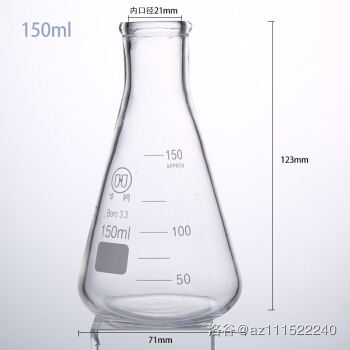
Answer: let the atmospheric pressure is $p_0$, density of liquid is $\rho$, height of liquid is $h$, bottom area of flask is $S$, mass of liquid is $m$. then the force from the liquid is $F_1=p_0 S+\rho ghS$, force from the flask is $F_2=p_0 S+mg$. Clearly $m<\rho ghS$ since the capacity of surface declines as the height grows. (就因为它是锥形瓶子,不会翻译QAQ). so $F_1>F_2$.
---
## 电磁学:
(暂时没有灵感,有的话回来填坑)
---
## 热学:
1, discuss the differene between internal energy, heat and temperature.
Answer: internal energy is the average total energy of molecules due to the random movement of molecules. it indipendently exists.
heat is the energy transfer when there is a transfer of energy, more specifically, the change in energy during the transfer process. it cannot indipendently exist.
temperature measures the average kinetic energy of molecules, it also can indipendently exist.
---
2, in winter people light a fire to get warm inside their homes. but one house leaks air. someone lights a fire in this house, which of the following statements is correct? (1) the temperature inside the house increases. (2) the internal energy inside the house increases. (3) (bonus) the enthalpy inside the house increases.
Answer: (1) correct. (2) incorrect, the energy produced by the fire is carried away by the leaking air, so it doesn't change. (3) incorrect, doesn't change as well.
---
3, is opening the door of refrigerator helpful to lowering the temperature of room? why?
Answer: not helpful. because refrigerator works by giving out excessive energy to the room and keep the temperature of inside lower. but there exists heat (here the heat we hope to reduce) loss, therefore more heat will be given out to the room and increases the temperature of the room.
----
## 光学:
1, explain why there is round spot at ground when the sunshine passes through the small gap of leaves.
Answer: the theory is pin-hole imaging (小孔成像,不会翻译QAQ)
---
2, explain why the reflected image of object above a river became longer when there is small water wave on the river (荡漾水波,不会翻译QAQ)
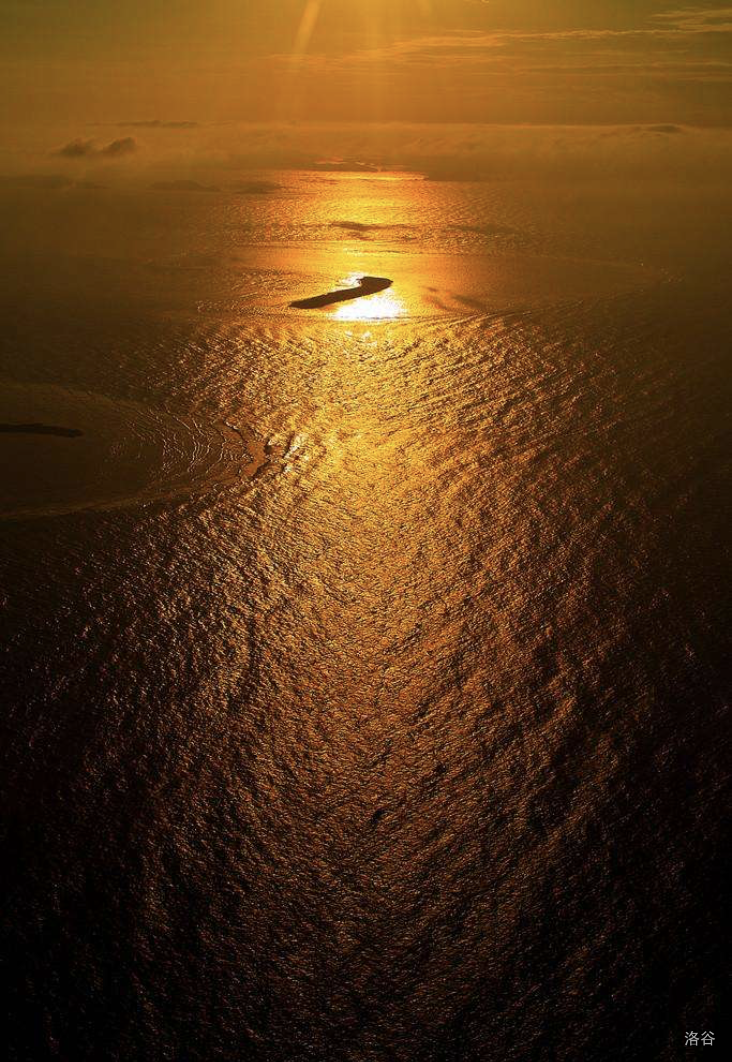
Answer: every small part of wave acts as a small mirror that reflects the image of object. since the water is horizontal, we cannot see those points on the top of object, so the virtual image seen is a vertically magnified image.
----
3, on the graph provided, draw the path of the incident ray passing one focus of a divergine lens. Keep your auxiliary lines on the graph. also prove that your result is correct by calculations.
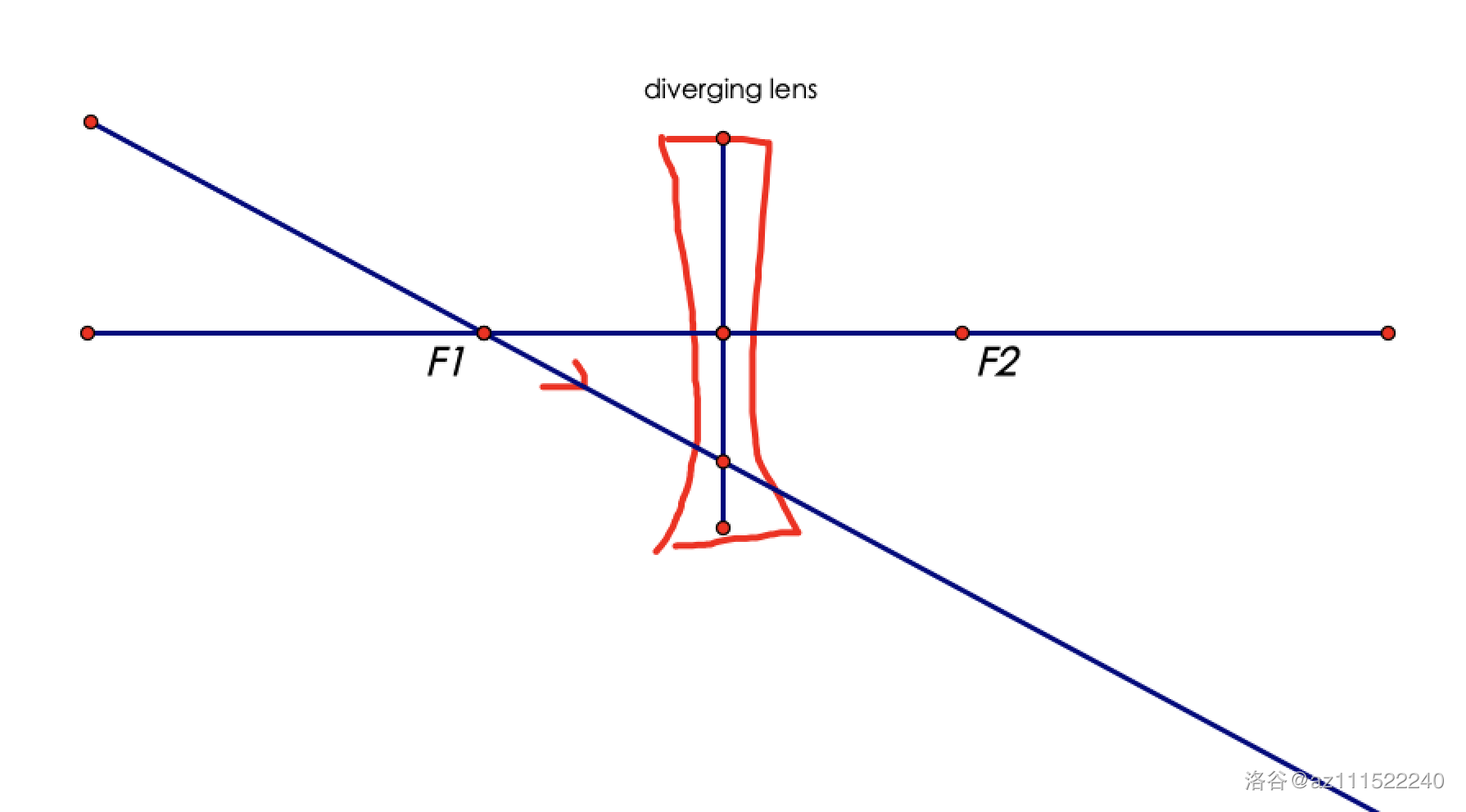
Answer:
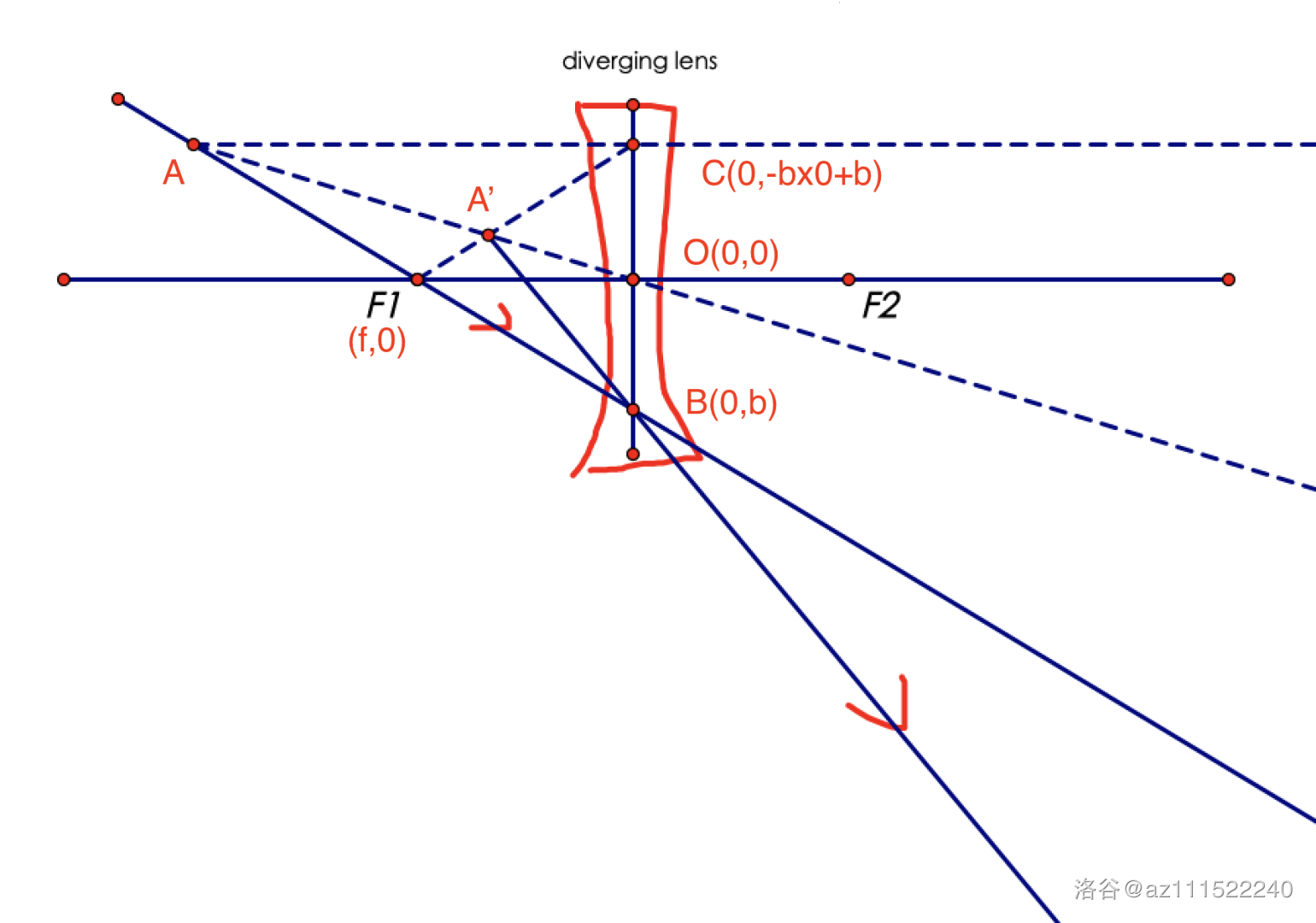
the point $A'$ is the position of image of point $A$. therefore the ray emitted starts at point $A'$.
Proof that the ray emitted won't change whatever the position of $A$ is on a certain incident ray:
then we have: $F_1B:y=-\dfrac{b}{f}x+b$, where $A$ lies on it. assume $A(fx_0,-bx_0+b) AO: y=\dfrac{-bx_0+b}{fx_0}xF_1C:y=\dfrac{bx_0-b}{f}x+(-bx_0+b)A'$ is the intercept of $AO$ and $F_1C$, so $A'(\dfrac{fx_0}{x_0+1},\dfrac{-bx_0+b}{x_0+1})
the ray emitted is A'B:y=\dfrac{-2b}{f}x+b, which is totally indipendent with A, or x_0
其他:
Define physics.
Answer: Physics is a science that deals with matter and energy and their interactions.