题解 P6362 【平面欧几里得最小生成树】
Mr_Skirt
·
·
题解
提供一个 Bowyer-Watson 算法的期望O(n\log{n})实现方案。朴素的 Bowyer-Watson 算法求Delaunay三角剖分实现复杂度是O(n^2)的,而我使用的这个算法基于的是随机增量方法,虽然时间复杂度看起来不对,但由于我们是随机的选择插入顺序,超过n\log{n}的情况几乎不存在。
算法流程
整个算法的流程是这样的
- 一开始先构造一个极大三角形,然后打乱插入点集的顺序。
- 每次插入一个点 p,确定这个点在哪个三角形,同时把这个三角形三个顶点连接插入点分成三份,分别命名为 a,b,c。
- 对于 a,b,c 三个三角形,我们把所有不包含 p 的边标记为可疑边。
- 对于所有可疑边,我们选择与插入点 p 根据可疑边对立的顶点 q。设可疑边两个顶点为 x, y。此时 p,x,q,y 组成了一个四边形,如果 q 在 p, x, y 组成的圆里,那么我们要对四边形 p,x,q,y 进行边翻转操作。
- 如果进行了边翻转操作,我们要把 qx, qy 也标记为可疑边。
- 对所有可疑边都进行边翻转操作,当不存在任何可疑边的时候插入就结束了。
- 插入完所有点后算法就结束了。
难点
这个算法本身包含几个难点:
- 如何高效的找到可疑边和对立点?
- 如果高效的进行点定位(Point Location)操作?即确定插入点落在哪个三角形内部?
- 如何判断点是否在某三个点的外接圆内部?
第三个问题在@Tweetuzki的题解里已经解释的非常详细了,我这里就直接引用他的方法了。
平面图表示方法
第一个问题可以使用一个叫做DCEL(doubly connected edge list,即双向链接边表)的结构实现,对于这个问题我进行了一点简化,使用的是单向链接边表。
这个数据结构是由三个基本结构组成的,我们知道在平面图中有三个重要组成元素:顶点,边,面。
顶点很好表示,我们只关心它的位置。
对于边和面来说,我们需要记录更多信息。为了能够知道这个边组成了哪个面,我们需要对边进行定向,如果某一些边逆时针可以组成一个面,那么就说这些边是这个面的组成边,这个面就成为这些边的组成面,如图所示
除此之外,为了能够遍历一个面的所有组成边,对于每一个边我们规定它的**前驱**指针指向构成这个面的逆时针下一条边。比如说,$ca$ 这条边的**前驱**就是边 $ab$。
最后,为了能够获取对立顶点,我们需要由一个跨面的操作,即从面 $A$ 跨越到它的邻接面 $B$,我们只需要知道 $ac$ 边的**孪生边** $ca$ 即可。 $ca$ 的组成面就是 $B$。我们要对每条边都维护这么一个**孪生边**。
假设我们想要获得 $b$ 对于边 $ac$ 的对立顶点,只需要先获得 $ac$ 边,然后找到其**孪生边**的前驱即可。
至此,我们就完成了对于这么一个平面的图的表示,以下是这三个结构的抽象表示方法:
```cpp
struct Edge {
// 边的起点
Vertex* from;
// 边的终点
Vertex* to;
// 孪生边
Edge* twin;
// 组成面
Face* face;
// 前驱边
Edge* next;
int id;
};
struct Face {
int id;
// 其中一个组成边
Edge* edge;
};
struct Vertex {
int id;
Vector2 pos;
};
```
## 高效点定位
在线的点定位(Point Location)问题通常需要复杂的数据结构,比如Kirpatrick的算法和梯形图(Trapezoidal Map)算法。这些算法可以实现单点期望 $O(\log{n})$ 的查询效率,但是代码极其难写且边界条件众多。(当年上计算几何课写这个差点没把我送走QAQ
对于这道题来说,我们有个优势就是可以使用离线的算法,而且出乎意料的是,这个算法极其简单,复杂度和随即增量算法一样看起来很高,但是由于随机性,这个点定位可以在期望均摊 $O(n)$ 的时间解决。
这个方法就是,对于所有三角形的面我们用一个列表记录哪些点在这个三角形内,每次三角形有变动的时候我们暴力重新分配这些点,仅此而已。看起来很暴力,但是效率奇高(并不是因为数据弱哦)。
这样我们对每个顶点维护一下它落在属于哪个面即可。
# 实现细节
## 输入点扰动
为了避免重点、三点共线、四点共圆等等的边界条件,我们要先对输入点进行微小扰动。
```cpp
static std::mt19937 mt;
void shake() {
pos.x += (mt.max() / 2 - mt()) / (double)mt.max() * 2 * EPS;
pos.y += (mt.max() / 2 - mt()) / (double)mt.max() * 2 * EPS;
}
```
## 遍历可疑边
每次插入一个点,我们确认了落在哪个三角形内部以后,分裂出来的三个三角形的向外的边都会被标记为可疑边,为了能够按照顺序处理,我们维护一个队列即可,进行边翻转以后加入新的可疑边进队列即可,伪代码:
```cpp
std::queue<Edge*> Q;
while (!Q.empty()) {
auto curEdge = Q.front();
Q.pop();
// 如果没有孪生边就略过
auto twin = curEdge->twin;
if (!twin) continue;
auto target = twin->next->to;
// 判断对立顶点是否在外接圆内
if (inCircumcircle(curEdge->from, curEdge->to, P, target)) {
// 进行边翻转,同时加入新的可疑边
}
}
```
## 边翻转
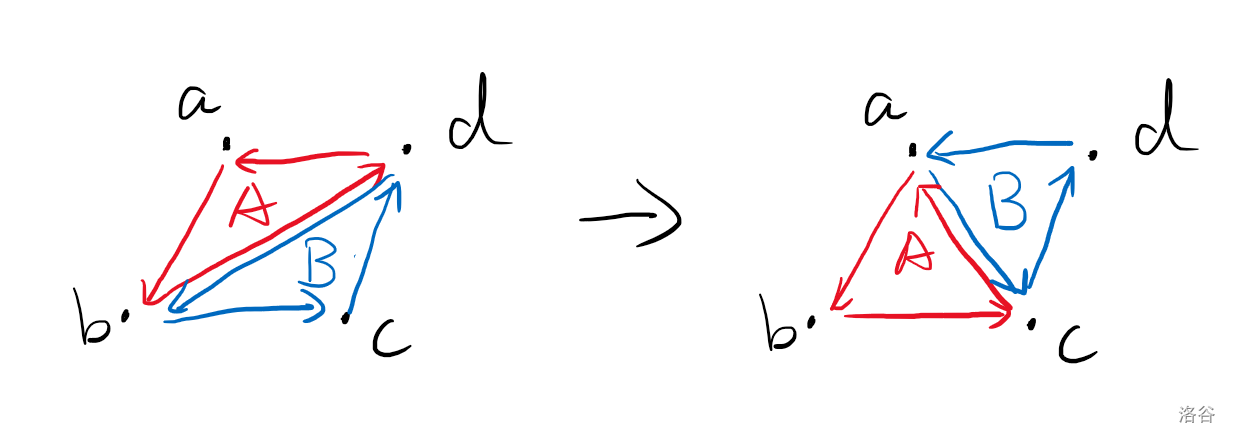
我们只需要把两个对立顶点的边翻转到另外两个对立顶点即可,注意在这个过程中我们并不需要增加和删除面,我们可以在原来的边和面上进行操作,首先把边的两个顶点换掉,然后对于这两个面,重新连接边,以及前驱。
在这个过程中也别忘了把之前两个面覆盖的顶点拿出来,并且在边翻转结束后重新更新每个顶点的所属面。
```cpp
auto A = curEdge -> face;
auto B = twin -> face;
// 提取出覆盖了的顶点
std::vector<Vertex*> cover;
for (auto vs : A->owned) {
cover.push_back(vs);
}
for (auto vs : B->owned) {
cover.push_back(vs);
}
// 重组AB面
// ......
// 这部分代码略去留给读者自己思考
for (auto vs : cover) {
// 剔除掉没必要更新的点
if (vs->id == P->id) continue;
// 每个顶点重新判断所属面
if (!vs->testInTriangle(A)) {
vs->belong = B;
B->owned.push_back(vs);
}
}
```
## 打碎原三角形
与上面的边翻转一样,这里我们也没必要生成三个新的三角形,而是只生成两个,然后另一个使用原三角形。更新顶点所属面和上面一样暴力。
至此这个随机增量算法的大部分细节就都介绍完毕了,对于这题剩下的只要遍历所有边然后求最小生成树即可。截止目前,这个“纯暴力”算法是跑的最快的提交,我的代码还有很多地方没有优化,比如把指针替换为数组下标,以及比较优雅的判断点是否在面内的算法。
由此可以看出,随机化思想在计算几何中的重要性,它允许了我们用极其优雅和简单的方式解决困难的问题。
算法本身实现非常简单,但是时间复杂度直到1992年的论文[Randomized Incremental Construction of Delaunay and Voronoi Diagrams](http://www.wias-berlin.de/people/si/course/files/Guibas92-RandomizeIncr.pdf)才真正的确认为期望$O(n\log{n})$。
参考代码(很长,但是大部分代码都是数据结构的表示以及向量的板子,核心就是insert函数)
```cpp
#include <algorithm>
#include <cassert>
#include <cstdio>
#include <cstring>
#include <ctime>
#include <iostream>
#include <map>
#include <queue>
#include <random>
#include <set>
#include <vector>
typedef long long ll;
typedef unsigned long long ull;
typedef long double LD;
const int INF = 2147483647;
const int INF2 = 0x3f3f3f3f;
const ll INF64 = 1e18;
const double INFD = 1e30;
const double PI = acos(-1);
const int MOD = 1e9 + 7;
template <typename T>
inline T read() {
T X = 0, w = 0;
char ch = 0;
while (!isdigit(ch)) {
w |= ch == '-';
ch = getchar();
}
while (isdigit(ch)) X = (X << 3) + (X << 1) + (ch ^ 48), ch = getchar();
return w ? -X : X;
}
int n, m;
int dr[4] = {1, 0, -1, 0};
int dc[4] = {0, 1, 0, -1};
int dr2[8] = {1, 1, 1, -1, -1, -1, 0, 0};
int dc2[8] = {1, 0, -1, 1, 0, -1, 1, -1};
int CASE = 1;
constexpr int MAXN = 100010;
constexpr double EPS = 1e-10;
static std::mt19937 mt;
int dcmp(double x) {
if (fabs(x) < EPS) return 0;
return x > 0 ? 1 : -1;
}
struct Vector2 {
double x, y;
Vector2() : x(0), y(0) {}
Vector2(double x, double y) : x(x), y(y) {}
Vector2(double rad) : x(cos(rad)), y(sin(rad)) {}
static double dot(const Vector2& a, const Vector2& b) {
return a.x * b.x + a.y * b.y;
}
static double angle(const Vector2& a, const Vector2& b) {
return acos(dot(a, b) / a.length() / b.length());
}
static double cross(const Vector2& a, const Vector2& b) {
return a.x * b.y - a.y * b.x;
}
static double area2(const Vector2& a, const Vector2& b, const Vector2& c) {
return cross(b - a, c - a);
}
double length() const { return std::sqrt(x * x + y * y); }
double lengthSq() const { return x * x + y * y; }
double getRad() const { return atan2(y, x); }
Vector2 rotate(double rad) const {
return Vector2(x * cos(rad) - y * sin(rad),
x * sin(rad) + y * cos(rad));
}
Vector2 unit() const {
double l = this->length();
return Vector2(x / l, y / l);
}
Vector2 normal() const {
double l = this->length();
return Vector2(-y / l, x / l);
}
bool operator<(const Vector2& other) const {
return x < other.x || (x == other.x && y < other.y);
}
bool operator==(const Vector2& other) const {
return !dcmp(x - other.x) && !dcmp(y - other.y);
}
Vector2& operator+=(const Vector2& vec) {
this->x += vec.x, this->y += vec.y;
return *this;
}
Vector2 operator+(const Vector2& vec) const {
return Vector2(this->x + vec.x, this->y + vec.y);
}
Vector2& operator-=(const Vector2& vec) {
this->x -= vec.x, this->y -= vec.y;
return *this;
}
Vector2 operator-(const Vector2& vec) const {
return Vector2(this->x - vec.x, this->y - vec.y);
}
Vector2& operator*=(double v) {
this->x *= v, this->y *= v;
return *this;
}
Vector2& operator*=(const Vector2& v) {
this->x *= v.x, this->y *= v.y;
return *this;
}
Vector2 operator*(double v) const {
return Vector2(this->x * v, this->y * v);
}
Vector2 operator*(const Vector2& vec) const {
return Vector2(this->x * vec.x, this->y * vec.y);
}
Vector2& operator/=(double v) {
this->x /= v, this->y /= v;
return *this;
}
Vector2& operator/=(const Vector2& vec) {
this->x /= vec.x, this->y /= vec.y;
return *this;
}
Vector2 operator/(double v) const {
return Vector2(this->x / v, this->y / v);
}
Vector2 operator/(const Vector2& vec) const {
return Vector2(this->x / vec.x, this->y / vec.y);
}
};
struct Face;
struct Vertex;
struct Edge;
struct Edge {
Vertex* from;
Vertex* to;
Edge* twin;
Face* face;
Edge* next;
int id;
Edge()
: from(nullptr),
to(nullptr),
twin(nullptr),
face(nullptr),
next(nullptr),
id(0) {}
Edge(Vertex* fr, Vertex* to)
: from(fr),
to(to),
twin(nullptr),
face(nullptr),
next(nullptr),
id(0) {}
};
struct Face {
int id;
Edge* edge;
std::vector<Vertex*> owned;
Face() : id(0), edge(nullptr) {}
Face(int id, Edge* edge) : id(id), edge(edge) {}
};
struct Vertex {
int id;
Face* belong;
Vector2 pos;
Vertex() : id(0), belong(nullptr), pos() {}
Vertex(int id, double x, double y) : id(id), belong(nullptr), pos(x, y) {}
void shake() {
pos.x += (mt.max() / 2 - mt()) / (double)mt.max() * 2 * EPS;
pos.y += (mt.max() / 2 - mt()) / (double)mt.max() * 2 * EPS;
}
// 非常暴力地判断点是否在面内部
bool testInTriangle(Face* face) {
auto e = face->edge;
for (int i = 0; i < 3; i++) {
auto dir = e->to->pos - e->from->pos;
auto p = pos - e->from->pos;
if (Vector2::cross(dir, p) < 0) return false;
e = e->next;
}
belong = face;
face->owned.push_back(this);
return true;
}
};
Vertex vPool[MAXN];
int totV;
Face fPool[MAXN * 2];
int totF;
Edge ePool[MAXN * 6];
int totE;
typedef struct vec3_t {
double x, y, z;
vec3_t(double _x = 0, double _y = 0, double _z = 0) {
x = _x, y = _y, z = _z;
}
inline friend vec3_t operator+(const vec3_t& a, const vec3_t& b) {
return vec3_t(a.x + b.x, a.y + b.y, a.z + b.z);
}
inline friend vec3_t operator-(const vec3_t& a, const vec3_t& b) {
return vec3_t(a.x - b.x, a.y - b.y, a.z - b.z);
}
inline friend vec3_t operator*(const vec3_t& a, double k) {
return vec3_t(a.x * k, a.y * k, a.z * k);
}
inline friend vec3_t cross(const vec3_t& a, const vec3_t& b) {
return vec3_t(a.y * b.z - a.z * b.y, a.z * b.x - a.x * b.z,
a.x * b.y - a.y * b.x);
}
inline friend double dot(const vec3_t& a, const vec3_t& b) {
return a.x * b.x + a.y * b.y + a.z * b.z;
}
} node3_t;
bool inCircumcircle(Vertex* a, Vertex* b, Vertex* c, Vertex* d) {
vec3_t A = vec3_t(a->pos.x, a->pos.y, Vector2::dot(a->pos, a->pos));
vec3_t B = vec3_t(b->pos.x, b->pos.y, Vector2::dot(b->pos, b->pos));
vec3_t C = vec3_t(c->pos.x, c->pos.y, Vector2::dot(c->pos, c->pos));
vec3_t D = vec3_t(d->pos.x, d->pos.y, Vector2::dot(d->pos, d->pos));
if (Vector2::cross(b->pos - a->pos, c->pos - a->pos) < 0) std::swap(B, C);
node3_t normal = cross(B - A, C - A);
if (dot(normal, D - A) > EPS)
return false;
else
return true;
}
Vertex* newVertex(double x, double y) {
++totV;
vPool[totV] = Vertex(totV, x, y);
return &vPool[totV];
}
Edge* newEdge(Vertex* fr, Vertex* to) {
++totE;
ePool[totE] = Edge(fr, to);
ePool[totE].id = totE;
return &ePool[totE];
}
// 创造一个以abc为逆时针顶点的三角形面
void constructNewFace(Face* face, Vertex* a, Vertex* b, Vertex* c) {
Edge* edges[3];
edges[0] = newEdge(a, b);
edges[1] = newEdge(b, c);
edges[2] = newEdge(c, a);
for (int i = 0; i < 3; i++) {
edges[i]->next = edges[(i + 1) % 3];
edges[i]->face = face;
}
face->edge = edges[0];
}
// 创造一个以边abc为逆时针顺序的组成面
void constructFace(Face* face, Edge* a, Edge* b, Edge* c) {
Edge* edges[3];
edges[0] = a;
edges[1] = b;
edges[2] = c;
for (int i = 0; i < 3; i++) {
edges[i]->next = edges[(i + 1) % 3];
edges[i]->face = face;
}
face->edge = a;
}
Face* newFace() {
totF++;
fPool[totF].id = totF;
return &fPool[totF];
}
Vector2 PT[MAXN];
void insert(int x) {
Vertex* v = &vPool[x];
Face* face = v->belong;
// 打碎原三角形,生成三个新的三角形
auto fEdge = face->edge;
Face* nFaces[3];
nFaces[0] = face;
nFaces[1] = newFace();
nFaces[2] = newFace();
// nEdges 是逆时针的第一条边,cEdges是组成面的逆时针最后一条边
Edge* nEdges[3];
Edge* cEdges[3];
Edge* oEdges[3];
for (int i = 0; i < 3; i++) {
nEdges[i] = newEdge(v, fEdge->from);
cEdges[i] = newEdge(fEdge->to, v);
oEdges[i] = fEdge;
fEdge = fEdge->next;
}
for (int i = 0; i < 3; i++) {
constructFace(nFaces[i], nEdges[i], oEdges[i], cEdges[i]);
nEdges[i]->twin = cEdges[(i + 2) % 3];
cEdges[(i + 2) % 3]->twin = nEdges[i];
}
std::vector<Vertex*> children(nFaces[0]->owned.begin(),
nFaces[0]->owned.end());
for (int i = 0; i < 3; i++) {
nFaces[i]->owned.clear();
}
for (auto vs : children) {
if (vs->id == v->id) continue;
for (int i = 0; i < 3; i++) {
if (vs->testInTriangle(nFaces[i])) break;
}
}
std::queue<Edge*> Q;
for (int i = 0; i < 3; i++) {
Q.push(oEdges[i]);
}
while (!Q.empty()) {
auto curEdge = Q.front();
Q.pop();
auto twin = curEdge->twin;
if (!twin) continue;
auto targetV = twin->next->to;
if (targetV == v) continue;
if (inCircumcircle(curEdge->from, curEdge->to, v, targetV)) {
auto nxt1 = twin->next;
// 添加可疑边
Q.push(nxt1), Q.push(nxt1->next);
auto A = curEdge->face;
auto B = twin->face;
assert(A != B);
children.clear();
for (auto vs : A->owned) children.push_back(vs);
for (auto vs : B->owned) children.push_back(vs);
A->owned.clear();
B->owned.clear();
auto lastNxt = curEdge->next;
auto lastPrev = lastNxt->next;
// Do edge flip
curEdge->from = v, curEdge->to = targetV;
twin->from = targetV, twin->to = v;
constructFace(A, curEdge, nxt1->next, lastNxt);
constructFace(B, twin, lastPrev, nxt1);
for (auto vs : children) {
if (vs->id == v->id) continue;
if (!vs->testInTriangle(A)) {
vs->belong = B;
B->owned.push_back(vs);
}
}
}
}
}
struct UnionFind {
void clear(int n) {
for (int i = 0; i <= n; i++) fa[i] = i;
}
void join(int x, int y) {
int a = find(x), b = find(y);
fa[a] = b;
}
int find(int x) { return (fa[x] == x) ? x : fa[x] = find(fa[x]); }
int fa[MAXN];
};
UnionFind uf;
struct E2 {
int x, y;
double w;
bool operator<(const E2& e) const { return w < e.w; }
};
std::vector<E2> edges;
int main() {
#ifdef LOCALLL
freopen("in", "r", stdin);
freopen("out", "w", stdout);
#endif
mt.seed(19260817);
scanf("%d", &n);
uf.clear(n);
for (int i = 1; i <= n; i++) {
scanf("%lf %lf", &PT[i].x, &PT[i].y);
vPool[++totV] = Vertex(i, PT[i].x, PT[i].y);
vPool[totV].shake();
}
std::random_shuffle(vPool + 1, vPool + totV + 1,
[](int x) { return mt() % x; });
auto a = newVertex(1e6, 1e6);
auto b = newVertex(-1e6, 1e6);
auto c = newVertex(-1e6, -1e6);
auto d = newVertex(1e6, -1e6);
auto f1 = newFace();
auto f2 = newFace();
constructNewFace(f1, a, b, d);
constructNewFace(f2, d, b, c);
f1->edge->next->twin = f2->edge;
f2->edge->twin = f1->edge->next;
for (int i = 1; i <= n; i++) {
Vertex& v = vPool[i];
if (!v.testInTriangle(f1)) {
v.belong = f2;
f2->owned.push_back(&vPool[i]);
}
}
for (int i = 1; i <= n; i++) {
insert(i);
}
for (int i = 1; i <= totF; i++) {
auto e = fPool[i].edge;
for (int j = 0; j < 3; j++) {
int u = e->from->id, v = e->to->id;
if (u <= n && v <= n) {
edges.push_back({u, v, (PT[v] - PT[u]).length()});
}
e = e->next;
}
}
std::sort(edges.begin(), edges.end());
double ans = 0;
for (auto& e : edges) {
if (uf.find(e.x) != uf.find(e.y)) {
ans += e.w;
uf.join(e.x, e.y);
}
}
printf("%.6lf\n", ans);
return 0;
}
```
补充一个比较好玩的,如果要从Delaunay三角剖分求出其对偶Voronoi图,我们可以对于每个三角形面求出外心,然后连接其三个邻接面的外心即可,看图:
