题解:P8194 [USACO22FEB] Phone Numbers P
priority__queue
·
·
题解
2026.09.26 upd. 修改了错误的代码3
约定
- 如果一个电话号码可能是给定的字符串的某个前缀的可能想输入的电话号码,我们就称其为“好字符串”。
- 下文中的电话号码均以字符串的形式理解。
- 如果一个字符串 a 与字符串 b 的可重字符集相同,我们就称 a 与 b 是同构的。
思路
step 1 设计 dp 状态
首先发现有一个很基础的思路,就是设 dp_{i,j} 表示前 i 个字符中结尾 3 个字符为 j 的“好字符串”的方案数。
然后 dp_{i,j} 要从 dp_{i-1, a},dp_{i-2, b},dp_{i-4, c} 等转移。
但是这样会算重。
:::info[例子]
:::
我们发现问题在于 $dp_{i,j}$ 和 $dp_{i-1, k}$ 中有重叠的方案,但是我们在转移中又没有将他们“隔离”,即有转移方程同时包含 $dp_{i,j}$ 和 $dp_{i-1, k}$。
考虑如何解决,我们可以把他们强行隔离开来,即把总体转移方式变为 $dp_{i-1} \to dp_i$,提前钦定一个字符串的字符。
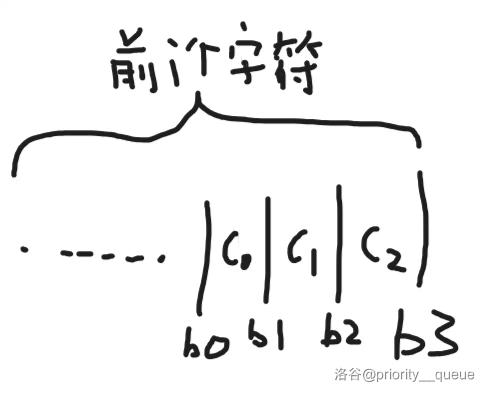
具体状态为 $dp_{i,b0,b1,b2,b3,c}$($b0,b1,b2,b3$ 为布尔值,$c$ 为包含 $3$ 个字符的字符串)表示前 $i$ 个字符中最后 $3$ 个字符为 $c$ 的满足以下条件的好字符串的数量:
- 若 $b0 = 1$,则前 $i-3$ 个字符的字符串是“好字符串”。
- 若 $b1 = 1$,则前 $i-2$ 个字符的字符串是“好字符串”。
- 若 $b2 = 1$,则前 $i-1$ 个字符的字符串是“好字符串”。
- 若 $b3 = 1$,则前 $i$ 个字符的字符串是“好字符串”。
给个图理解一下:
## step 2 转移,答案,边界条件
答案就是 $dp_{n, any, any, any, 1, any}$ 的方案数($any$ 表示值无所谓)。
考虑向后转移。
设给定的字符串为 $s$,当前在转移 $dp_{i,b0,b1,b2,b3,c}$。
我们枚举第 $i+1$ 个字符是什么。
假设第 $i+1$ 个字符为 $t$,我们要转移到的状态为 $dp_{i+1, d0, d1, d2, d3, e}$。
首先将 $d0 \leftarrow b1$,$d1 \leftarrow b2$ ,$d2 \leftarrow b3$, $e$ 设为 $c[1 .. 2]+t$ 。
然后进行如下操作:
如果 $t = s_{i+1}$,`d3 = d3 || b3`。
如果 $s[i \ldots i+1]$ 是合法输入,且 $s[i \ldots i+1]$ 与 $e[2 \ldots 3]$ 同构,`d3 = d3 || b2`。
如果 $s[i-2 \ldots i+1]$ 是合法输入,且 $s[i-2 \ldots i+1]$ 与 $e$ 同构,`d3 = d3 || b0`。
然后就转移完成了。
边界条件是 $dp_{0, 0, 0, 0, 1, \texttt{000}} = 1$。
时间复杂度 $O(n)$,常数 $2^4 \times 9^4$(转移常数为 $9$),需要优化,具体常数优化在实现部分。
# 实现
这题的实现有挺多可以说的。
首先我们发现如果 $b0, b1, b2, b3$ 均等于 $0$,那么这个状态就可以丢弃了。
我们拟出第一版代码:
:::success[代码1(12pts)]
`state` 表示一个状态。
函数 `eq` 检查两个字符串是否同构。
函数 `check` 检查一个字符串是否是可输入的。
```cpp
#include <bits/stdc++.h>
using namespace std;
#define fir first
#define sec second
#define low_b lower_bound
#define upp_b upper_bound
#define imod(x) ((x)-((x) >= MOD)*MOD)
template <class Vec_T>
using vc=vector<Vec_T>;
const int MOD=1e9+7;
const vc<string> chk_sz2={"12", "23", "45", "56", "78", "89", "14", "25", "36", "47", "58", "69"};
const vc<string> chk_sz4={"1245", "2356", "4578", "5689"};
bool eq(string s1, string s2){
sort(s1.begin(), s1.end());
sort(s2.begin(), s2.end());
return s1 == s2;
}
bool check(string s){
sort(s.begin(), s.end());
if(s.size() == 1) return 1;
else if(s.size() == 2 && find(chk_sz2.begin(), chk_sz2.end(), s) != chk_sz2.end()) return 1;
else if(s.size() == 4 && find(chk_sz4.begin(), chk_sz4.end(), s) != chk_sz4.end()) return 1;
else return 0;
}
struct state{
string c="000";
vc<bool> b=vc<bool>(4);
int val=0;
bool operator==(const state &a) const{
return c == a.c && b == a.b && val == a.val;
}
bool operator<(const state &a) const{
return c < a.c || (c == a.c && b < a.b);
}
void trans(vc<state> &to, char s1, string s2="00", string s4="0000"){
for(char t='1';t <= '9';t++){
state res=*this;
res.b.erase(res.b.begin());
res.b.push_back(0);
if(s1 == t) res.b[3]=res.b[3] || b[3];
if(eq(s2, c.substr(2, 1)+t) && check(s2)) res.b[3]=res.b[3] || b[2];
if(eq(s4, c+t) && check(s4)) res.b[3]=res.b[3] || b[0];
res.c.erase(res.c.begin());
res.c+=t;
to.push_back(res);
}
}
};
int main(){
ios::sync_with_stdio(0);
cin.tie(0);cout.tie(0);
int T;
cin >> T;
while(T--){
string s;
cin >> s;
s=' '+s;
int n=s.size()-1;
vc<state> v0(1), v1;
v0[0].b[3]=1;
v0[0].val=1;
for(int i=1;i <= n;i++){
v1.clear();
for(state x : v0){
if(i <= 1) x.trans(v1, s[i]);
else if(i <= 3) x.trans(v1, s[i], s.substr(i-1, 2));
else x.trans(v1, s[i], s.substr(i-1, 2), s.substr(i-3, 4));
}
sort(v1.begin(), v1.end());
state pre;
v0.clear();
for(state x : v1){
if(x.b == vc<bool>(4, 0)) continue;
else if(x == pre){
v0.back().val=imod(v0.back().val+x.val);
}
else{
v0.push_back(x);
pre=x;
}
}
}
int ans=0;
for(state x : v0){
if(x.b[3] == 1){
ans=imod(ans+x.val);
}
}
cout << ans << "\n";
}
}
```
:::
首先我们发现每次排序后去重太慢了,我们实现一个 `to_int` 实现 `state` 与 `int` 的互相转换。
其次我们发现每次枚举每一个数字是多余的,我们只枚举当前位置的前后 $4$ 个字符(总共 $7$ 个字符就行了)。
:::success[代码2 56pts]
```cpp
#include <bits/stdc++.h>
using namespace std;
#define fir first
#define sec second
#define low_b lower_bound
#define upp_b upper_bound
#define imod(x) ((x)-((x) >= MOD)*MOD)
template <class Vec_T>
using vc=vector<Vec_T>;
const int MOD=1e9+7;
const vc<string> chk_sz2={"12", "23", "45", "56", "78", "89", "14", "25", "36", "47", "58", "69"};
const vc<string> chk_sz4={"1245", "2356", "4578", "5689"};
int dp[17005];
bool eq(string s1, string s2){
sort(s1.begin(), s1.end());
sort(s2.begin(), s2.end());
return s1 == s2;
}
bool check(string s){
sort(s.begin(), s.end());
if(s.size() == 1) return 1;
else if(s.size() == 2 && find(chk_sz2.begin(), chk_sz2.end(), s) != chk_sz2.end()) return 1;
else if(s.size() == 4 && find(chk_sz4.begin(), chk_sz4.end(), s) != chk_sz4.end()) return 1;
else return 0;
}
struct state{
string c="000";
vc<bool> b=vc<bool>(4);
int val=0;
bool operator==(const state &a) const{
return c == a.c && b == a.b && val == a.val;
}
bool operator<(const state &a) const{
return c < a.c || (c == a.c && b < a.b);
}
int to_int(){
return b[0]*1000+b[1]*2000+b[2]*4000+b[3]*8000+stoll(c);
}
void trans(vc<int> &to, vc<char> &v, char s1, string s2="", string s4=""){
for(char t : v){
state res=*this;
res.b.erase(res.b.begin());
res.b.push_back(0);
if(s1 == t) res.b[3]=res.b[3] || b[3];
if(eq(s2, c.substr(2, 1)+t) && check(s2)) res.b[3]=res.b[3] || b[2];
if(eq(s4, c+t) && check(s4)) res.b[3]=res.b[3] || b[0];
res.c.erase(res.c.begin());
res.c+=t;
int id=res.to_int();
if(dp[id] == 0){
to.push_back(id);
}
dp[id]=imod(dp[id]+val);
}
}
};
state to_state(int x){
int tmp=x/1000;
state res;
res.c="000";
res.c[0]+=x%1000/100;
res.c[1]+=x%100/10;
res.c[2]+=x%10;
res.b[0]=(tmp >> 0) & 1;
res.b[1]=(tmp >> 1) & 1;
res.b[2]=(tmp >> 2) & 1;
res.b[3]=(tmp >> 3) & 1;
return res;
}
int main(){
ios::sync_with_stdio(0);
cin.tie(0);cout.tie(0);
int T;
cin >> T;
while(T--){
string s;
cin >> s;
s=' '+s;
int n=s.size()-1;
vc<state> v0(1);
vc<int> v1;
v0[0].b[3]=1;
v0[0].val=1;
for(int i=1;i <= n;i++){
vc<char> V;
for(int j=max(1, i-3);j <= min(n, i+3);j++){
V.push_back(s[j]);
}
sort(V.begin(), V.end());
int m=unique(V.begin(), V.end())-V.begin();
V.assign(V.begin(), V.begin()+m);
v1.clear();
for(state x : v0){
if(i <= 1) x.trans(v1, V, s[i]);
else if(i <= 3) x.trans(v1, V, s[i], s.substr(i-1, 2));
else x.trans(v1, V, s[i], s.substr(i-1, 2), s.substr(i-3, 4));
}
v0.clear();
for(int x : v1){
state tmp=to_state(x);
tmp.val=dp[x];
dp[x]=0;
if(tmp.b == vc<bool>(4, 0)) continue;
v0.push_back(tmp);
}
}
int ans=0;
for(state x : v0){
if(x.b[3] == 1){
ans=imod(ans+x.val);
}
}
cout << ans << "\n";
}
}
```
:::
这份代码有两个瓶颈:
1. 每次 `check` 和 `eq` 太慢了。
2. `state` 本身常数太大了。
先解决第二个瓶颈。我们将原来的 `vc<bool>` 和 `string` 都换成 `int`。
然后再加点小剪枝就变成了这样。
:::success[代码3 56pts]
```cpp
#include <bits/stdc++.h>
using namespace std;
#define fir first
#define sec second
#define low_b lower_bound
#define upp_b upper_bound
#define imod(x) ((x)-((x) >= MOD)*MOD)
#define to_int(a, b) ((a)*1000+(b))
template <class Vec_T>
using vc=vector<Vec_T>;
const int MOD=1e9+7;
const vc<string> chk_sz2={"12", "23", "45", "56", "78", "89", "14", "25", "36", "47", "58", "69"};
const vc<string> chk_sz4={"1245", "2356", "4578", "5689"};
int dp[17005];
bool eq(string s1, string s2){
sort(s1.begin(), s1.end());
sort(s2.begin(), s2.end());
return s1 == s2;
}
bool check(string s){
sort(s.begin(), s.end());
if(s.size() == 1) return 1;
else if(s.size() == 2 && find(chk_sz2.begin(), chk_sz2.end(), s) != chk_sz2.end()) return 1;
else if(s.size() == 4 && find(chk_sz4.begin(), chk_sz4.end(), s) != chk_sz4.end()) return 1;
else return 0;
}
struct state{
int b=0, c=0, val=0;
bool operator==(const state &a) const{
return c == a.c && b == a.b && val == a.val;
}
bool operator<(const state &a) const{
return c < a.c || (c == a.c && b < a.b);
}
void trans(vc<int> &to, vc<char> &v, char &s1, string &s2, string &s4){
for(char t : v){
state res=*this;
res.b>>=1;
if(s1 == t) res.b |= (8*((b >> 3) & 1));
if(!((res.b >> 3) & 1) && eq(s2, to_string(c%10)+t) && check(s2)) res.b |= (8*((b >> 2) & 1));
if(!((res.b >> 3) & 1) && eq(s4, to_string(c)+t) && check(s4)) res.b |= 8*(((b >> 0) & 1));
res.c%=100;
res.c*=10;
res.c+=t-'0';
int id=to_int(res.b, res.c);
if(!((res.b >> 0) & 1)) res.c%=100;
if(dp[id] == 0){
to.push_back(id);
}
dp[id]=imod(dp[id]+val);
}
}
};
state to_state(int x){
return {x/1000, x%1000, 0};
}
int main(){
ios::sync_with_stdio(0);
cin.tie(0);cout.tie(0);
int T;
cin >> T;
while(T--){
string s;
cin >> s;
s=' '+s;
int n=s.size()-1;
vc<state> v0(1);
vc<int> v1;
v0[0].b=8;
v0[0].val=1;
for(int i=1;i <= n;i++){
vc<char> V;
for(int j=max(1, i-3);j <= min(n, i+3);j++){
V.push_back(s[j]);
}
sort(V.begin(), V.end());
int m=unique(V.begin(), V.end())-V.begin();
V.assign(V.begin(), V.begin()+m);
v1.clear();
string s2, s4;
if(i > 1) s2=s.substr(i-1, 2);
if(i > 3) s4=s.substr(i-3, 4);
for(state x : v0){
x.trans(v1, V, s[i], s2, s4);
}
v0.clear();
for(int x : v1){
state tmp=to_state(x);
tmp.val=dp[x];
dp[x]=0;
if(tmp.b == 0) continue;
v0.push_back(tmp);
}
}
int ans=0;
for(state x : v0){
if((x.b >> 3) & 1){
ans=imod(ans+x.val);
}
}
cout << ans << "\n";
}
}
```
:::
既然都用 `int` 表示状态了,那干脆把所有可以换的 `string` 都换成 `int`,然后提前对字符串排序以预处理 `check` 和 `eq`。
:::success[代码4 100pts 最终代码]
```cpp
#include <bits/stdc++.h>
using namespace std;
#define fir first
#define sec second
#define low_b lower_bound
#define upp_b upper_bound
#define imod(x) ((x)-((x) >= MOD)*MOD)
#define to_int(a, b) ((a)*1000+(b))
template <class Vec_T>
using vc=vector<Vec_T>;
const int MOD=1e9+7;
const vc<string> chk_all={"0001", "0002", "0003", "0004", "0005", "0006", "0007", "0008", "0009", "0012", "0023", "0045", "0056", "0078", "0089", "0014", "0025", "0036", "0047", "0058", "0069", "1245", "2356", "4578", "5689"};
int dp[17005], ssort[10005], chk[10005];
bool eq(string s1, string s2){
sort(s1.begin(), s1.end());
sort(s2.begin(), s2.end());
return s1 == s2;
}
bool eq(int s1, int s2){
return ssort[s1] == ssort[s2];
}
bool check(string s){
sort(s.begin(), s.end());
return (find(chk_all.begin(), chk_all.end(), s) != chk_all.end());
}
bool check(int x){
return chk[x];
}
struct state{
int b=0, c=0, val=0;
bool operator==(const state &a) const{
return c == a.c && b == a.b && val == a.val;
}
bool operator<(const state &a) const{
return c < a.c || (c == a.c && b < a.b);
}
void trans(vc<int> &to, vc<char> &v, int s1, int s2, int s4){
for(char t : v){
int num=t-'0';
state res=*this;
res.b>>=1;
if(s1 == num) res.b |= (8*((b >> 3) & 1));
if(!((res.b >> 3) & 1) && eq(s2, c%10*10+num) && check(s2)) res.b |= (8*((b >> 2) & 1));
if(!((res.b >> 3) & 1) && eq(s4, c*10+num) && check(s4)) res.b |= 8*(((b >> 0) & 1));
res.c%=100;
res.c*=10;
res.c+=t-'0';
int id=to_int(res.b, res.c);
if(dp[id] == 0){
to.push_back(id);
}
dp[id]=imod(dp[id]+val);
}
}
};
state to_state(int x){
return {x/1000, x%1000, 0};
}
int main(){
ios::sync_with_stdio(0);
cin.tie(0);cout.tie(0);
if(1){ // init
string blank="00000";
for(int i=0;i <= 10000;i++){
string s=to_string(i);
while(s.size() < 4) s='0'+s;
chk[i]=check(s);
sort(s.begin(), s.end());
ssort[i]=stoll(s);
}
}
int T;
cin >> T;
while(T--){
string s;
cin >> s;
s=' '+s;
int n=s.size()-1;
vc<state> v0(1);
vc<int> v1;
v0[0].b=8;
v0[0].val=1;
for(int i=1;i <= n;i++){
vc<char> V;
for(int j=max(1, i-3);j <= min(n, i+3);j++){
V.push_back(s[j]);
}
sort(V.begin(), V.end());
int m=unique(V.begin(), V.end())-V.begin();
V.assign(V.begin(), V.begin()+m);
v1.clear();
int s2=0, s4=0;
if(i > 1) s2=stoll(s.substr(i-1, 2));
if(i > 3) s4=stoll(s.substr(i-3, 4));
for(state x : v0){
x.trans(v1, V, s[i]-'0', s2, s4);
}
v0.clear();
for(int x : v1){
state tmp=to_state(x);
tmp.val=dp[x];
dp[x]=0;
if(tmp.b == 0) continue;
v0.push_back(tmp);
}
}
int ans=0;
for(state x : v0){
if((x.b >> 3) & 1){
ans=imod(ans+x.val);
}
}
cout << ans << "\n";
}
}
```
:::